
If you would like to get in touch, please feel free to contact: email hidden; JavaScript is required
Browse collection
- Full collection
- 18th Century & earlier
- Ackermann
- Africa
- Alken
- Animals
- Arabasia
- Architecture/Mansions
- Art
- Australasia
- Botany
- British Isles
- Caricatures
- Children
- China
- Chromo added colour
- Chromolithographs
- Conchology
- Costume
- Cruikshank
- Culture/Lifestyle
- Dutch
- East European
- Far East
- France
- Furniture/Antiques
- General
- Germany
- Grandville
- Heraldry
- History
- History - England
- History - Europe
- Holy Land
- India
- India - sepia
- Islam
- Italy
- Japan
- Literature
- London
- Manuscript
- Map
- Military
- Monnier
- Natural history
- Pastimes
- Pochoir
- Polar regions
- Portraits
- Religious/Christian
- Religious/other
- Rowlandson
- Russia
- Science
- Scrapbook
- Sepia
- South America
- Sports/Hunting
- Stamps
- Swiss
- The Americas
- Theatre
- Travel/Scenery
- Watercolours
- World
LE VAILLANT, Francois.
Voyage de M. Le Vaillant dans l'interieur de L'Afrique par Le Cap de Bonne Esperance...
Coming from a family of civil servants and jurists, François Levaillant studied ornithology in the natural history collections of Bécoeur and Mauduyt de la Vatenne. It was during a trip to the Netherlands that the Dutch East India Company hired him for a trip to the Cape province during which he collected many bird specimens as well as giraffe skin. He offered the whole thing to the Natural History Museum in Paris, which refused, and it was ultimately the Leiden museum that hosted his collection.




- Published
- Paris: Chez Leroy, Rue Saint-Jacques, 1790.
- References
- Mendelssohn 1, p. 889; Not in Abbey; Bobins I 102 (second edition, 22 plates 1795-6).
- Plates
- 9
- Binding/Size
- M=4to
- Value
- 0-5000
- Published
- Paris: Chez Leroy, Rue Saint-Jacques, 1790.
- Ref
- 1110
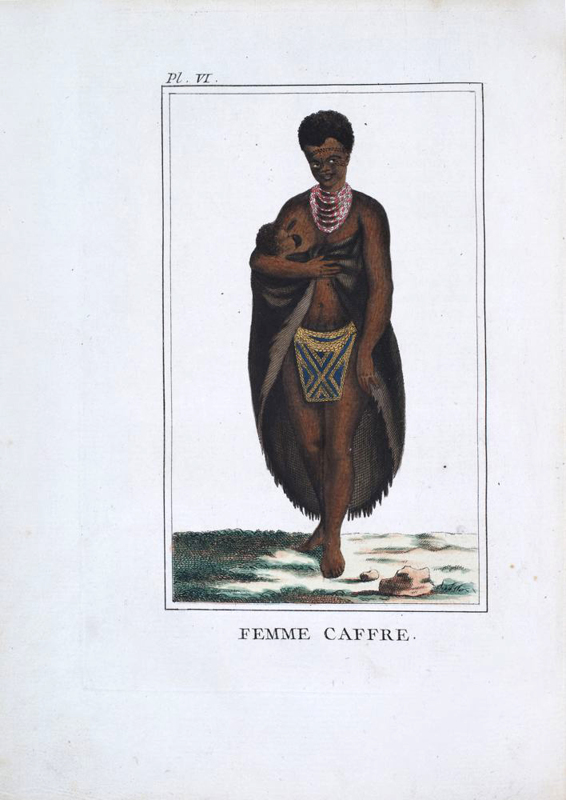
2 vols. in one. Large 4to. Original calf, spine gilt in compartments with black morocco title label lettered in gold, triple fillet line along the board edges of both sides, marbled endpapers. Boards rubbed and scuffed, corners slightly damaged and bumped. Bookplate affixed to front free endpaper. With engraved frontispiece of a camp in the Namaquois region, two folding plates with a view of Cape of Good Hope and another camp at Pampoen-kraal, and nine full-page plates of native people (a male (2) and female (3) Hottentot, a male and female kaffir, and a male and female giraffe, numbered I-VIII, VIII), all nine plates coloured by hand. Le Vaillant was born in Dutch Guiana in 1753 and, after being educated in Europe, went to Paris to study natural history. While there, he met Mr. Tremminck, Treasurer of the Dutch East India Company, who enabled him to fulfill his ambition and make for the Cape. Coloured plates in order: 1. Le Hottentot (male). 2. La Hottentot (female). 3. Narina, Jeune Gonaquoise (female). 4. Hottentot, Gonaquoi (male). 5. Le Caffre (male). 6. Femme Caffre. 7. Hottentote (female). 8. Girafe, Male. 9. Girafe, Femmelle.


