
If you would like to get in touch, please feel free to contact: email hidden; JavaScript is required
Browse collection
- Full collection
- 18th Century & earlier
- Ackermann
- Africa
- Alken
- Animals
- Arabasia
- Architecture/Mansions
- Art
- Australasia
- Botany
- British Isles
- Caricatures
- Children
- China
- Chromo added colour
- Chromolithographs
- Conchology
- Costume
- Cruikshank
- Culture/Lifestyle
- Dutch
- East European
- Far East
- France
- Furniture/Antiques
- General
- Germany
- Grandville
- Heraldry
- History
- History - England
- History - Europe
- Holy Land
- India
- India - sepia
- Islam
- Italy
- Japan
- Literature
- London
- Manuscript
- Map
- Military
- Monnier
- Natural history
- Pastimes
- Pochoir
- Polar regions
- Portraits
- Religious/Christian
- Religious/other
- Rowlandson
- Russia
- Science
- Scrapbook
- Sepia
- South America
- Sports/Hunting
- Stamps
- Swiss
- The Americas
- Theatre
- Travel/Scenery
- Watercolours
- World
WESTALL, William.
Matthew Flinders.
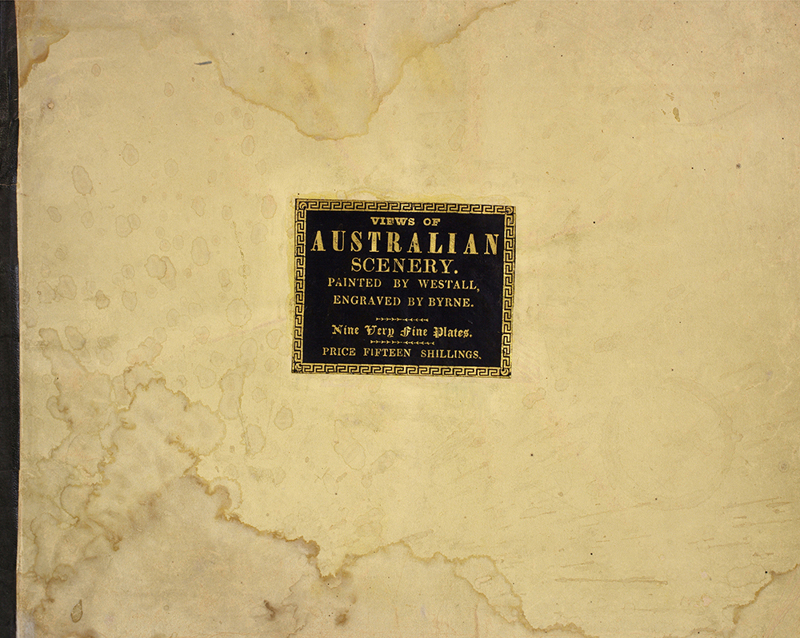
Views of Australian Scenery.
The book was based on engravings from Westall's work on A Voyage to Terra Australis, which was also published in 1814. His work is known for its accuracy and freshness, and some of his paintings depict Indigenous peoples.



- Published
- [London: 1814].
- References
- Wantrup 74b; Ferguson 598; Abbey Travel II 567; Bobins 1129.
- Plates
- 9
- Binding/Size
- M=4to
- Value
- 0-5000
- Published
- [London: 1814].
- Ref
- 5294
Landscape 4to, nine hand-coloured line engravings, original yellow wrappers, black calf label, preserved in new drop spine box. Westall was one of a group of young artists on board the Investigator, navigating around Australia from 1801-1803 under the command of Matthew Flinders. Westall survived a shipwreck and found the coast “barren” rather than picturesque. “I am sorry to say the Voyage to New Holland has not answered my expectations in any way.” The Voyage was one of the greatest scientific and botanical studies ever undertaken. Along with a team of talented artists and botanists, Flinders produced a fine visual record of Australia still treasured today. Westall’s landscape drawings, sketches, and paintings paved the way for an important tradition of Australian landscape painting, which developed in Australia in the nineteenth century. Westall’s elder brother, Richard, had secured a place at the Royal Academy for William. Other contemporaries, Constable and Turner, became famous for English landscapes. Westall’s work as a student came to the notice of Sir Joseph Banks, who settled on Westall for Flinder’s scientific expedition. The organisers required artists and botanists to help build up their records, but also in the hope of producing a publication that could help recoup the costs of the expedition. Ferdinand Bower was also on the expedition, which was in a race against France. Westall and his colleagues made expeditions inland, drawing the specimens they found. Westall also made pencil drawings of landscapes which interested him. One of his sketches was made from the top of Mount Brown in South Australia, following a sleepless night on the mountain. Coloured plates in order: 1. View of Malay Road, from Pobassoo's Island. 2. View in Sir Edward Pellew's Group - Gulph of Carpentaria. 3. View of Fort Brown from the hills behind the Watering Gully. 4. View of Port Jackson, taken from the South Head. 5. Entrance of Port Lincoln, taken from behind Memory Cove. 6. View on the north side of Kangaroo Island. 7. View of Murray's Islands, with the natives offering to barter. 8. View from the south side of King George's Sound. 9. View of Wreck-Reef Bank, taken at low water.


