If you would like to get in touch, please feel free to contact: email hidden; JavaScript is required
Browse collection
- Full collection
- 18th Century & earlier
- Ackermann
- Africa
- Alken
- Animals
- Arabasia
- Architecture/Mansions
- Art
- Australasia
- Botany
- British Isles
- Caricatures
- Children
- China
- Chromo added colour
- Chromolithographs
- Conchology
- Costume
- Cruikshank
- Culture/Lifestyle
- Dutch
- East European
- Far East
- France
- Furniture/Antiques
- General
- Germany
- Grandville
- Heraldry
- History
- History - England
- History - Europe
- Holy Land
- India
- India - sepia
- Islam
- Italy
- Japan
- Literature
- London
- Manuscript
- Map
- Military
- Monnier
- Natural history
- Pastimes
- Pochoir
- Polar regions
- Portraits
- Religious/Christian
- Religious/other
- Rowlandson
- Russia
- Science
- Scrapbook
- Sepia
- South America
- Sports/Hunting
- Stamps
- Swiss
- The Americas
- Theatre
- Travel/Scenery
- Watercolours
- World
SPIX, Johann Baptist von
C.F. Phil Von Martius.
Travels in Brazil in the Years 1817-1820. [Journey made at the command of H.M. Maximilian Joseph I King of Bavaria, 1817-1820].
A book by Johann Baptist von Spix and Carl Friedrich Philipp von Martius that was published in London in 1824. The book documents the travels of the two men, who were sent to Brazil by King Maximilian Joseph I of Bavaria. The two men were members of the Academy of Sciences in Munich. They were sent to Brazil under the protection of the Austrian embassy and with a recommendation to the Court of Rio de Janeiro. Extensive travels in the Rio, Sao Paulo, Vila Rica (Ouro Preto) areas with excellent demographic descriptions of urban, rural, and native populations.


- Published
- London: 1824.
- References
- BdM, p.829; Field 1472; Sabin 89551; Bobins 823. Not in Abbey Travel; The German edition is entitled Reise in Brasilien (Munich, 1831; not in Abbey Travel; a copy is known in the Philadelphia library).
- Plates
- 9
- Binding/Size
- S=8vo
- Value
- 0-5000
- Published
- London: 1824.
- Ref
- 5315
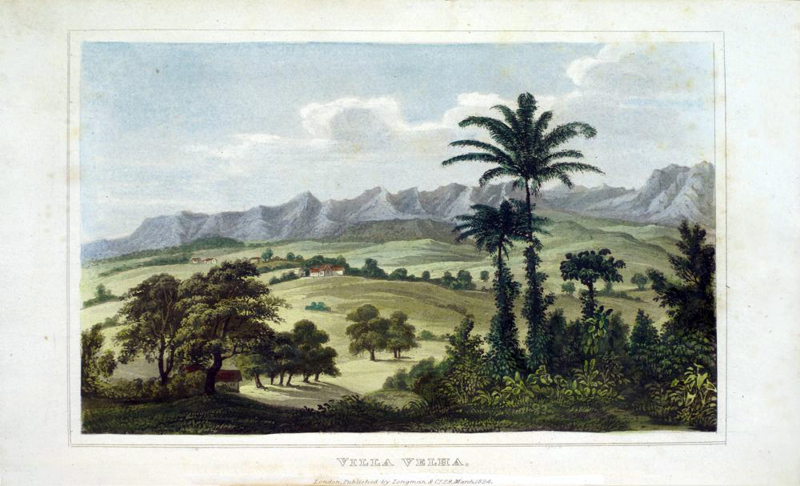
2 volumes of text, nine plates. Contemporary full calf gilt and blind. Bookplate of 'Edward Southwell Trafford' to front pastedown. Marbled endpapers and sides. In December 1819, the travelers arrived at Ega (Tefe) on the upper reaches of the Amazon river and decided to split to complete two individual journeys. Spix traveled the Upper Solimoes as far as the border with Peru and near the border with the Vice-Royalty of New Granada. He returned to Ega in February 1820, having reached Tabatinga on the Peruvian border. He then explored the Rio Negro before traveling to the Barra de Negro (modern Manaus). Martius traveled the Yapura up to the Arara-Coara falls. Their failure to return to Belem by December 1819 caused concern in Munich. After traveling for four weeks down the Amazon River, they arrived in April 1820, having first gone to Sao Paulo to acclimatise to the heat. There was an impressive list of predecessors to these travels: John Mawe, Wilhelm Ludwig von Eschwege, Maximilian Prinz zu Wied-Neuwied, Georg Ludwig Freiriss, Friedrich Sellow, Auguste de St Hilaire, as well as Georg Freiherr von Langsdorff. “With regard to these men as our predecessors and precursors as well as all written and verbal information, it seemed most expedient to journey first to the southern captaincy of S. Paulo, mainly to acclimatize ourselves gradually to the hot conditions we would encounter during our travels and acquaint ourselves with this more temperate southern zone. From the Captaincy of S. Paulo, we planned to travel through the interior of Minas Gerais to the S. Francisco River and Goyaz before continuing either down the Tocatins to Para or across the interior to Bahia and the coast, where we would arrange transport of our collections to Europe before penetrating the interior of the Captaincies of Piauhy and Maranhao to arrive finally at Para, the goal of our desires.” Despite all warnings from their Brazilian friends, Spix and Martius set out to realise their plan. With a mule-man, a drover, and a “newly bought negro slave,” as well as six pack-mules and two for riding, Spix and Martius left for the interior of Brazil. The first part of the journey for acclimatisation lasted until March 1818. At the end of March, the second part started when they left Villa Rica to travel through the Captaincies of Minas Gerais and Bahia Tao Salvador. In November 1818, the two scholars reached Salvador after an extremely arduous journey. They stayed there until mid-February 1819 in order to recover. Then they traveled through the Sertao to Sao Luiz. The route took the travelers through conditions of extreme privation and appalling lack of water through often uninhabited areas. In May, they traced a path to the southeast, then traveled to Joazeiro before continuing to Cidade de Oeiras, capital of the Captaincy of Piaui, alongside the Rio Caninde. On p. 781 of his report, Martius wrote: “The Catingas mostly consisted of sparse bushes and in the lowland areas, where there was much more water, the carnauva? palms formed stately forests, the sight of which was as strange as it was delightful. Blue Macaws (Psittacus hyacinthinus, Lath), which live in the dense tops of these palms, flew up screeching above us.” The blue macaws were specialist feeders of palm nuts, and Martius seems to be the first to observe and comment on this, and “has contributed to an understanding of this magnificent species.” Many of the plates were after drawings by Martius. Alexander von Humboldt praised the work with the following words: “For as long as palms are named and known, the name of Martius will be famous.” There is an illustration of South American birds and animals entitled “Fauna of tropical America.” Other plates include diamond washing at Curralinho and natives searching for diamonds on the gravel of the river bed. Coloured plates in order: Volume 1. 1. Frontispiece. Vella Velha. 2. [Portraits] A Coroado / A Botocudo. 3. Mandiocca, the Farm of Mr. V. Langsdorft. 4. A Mameluca of St. Paulo / A Cafusa of St. Paulo. Volume 2. 5. Frontispiece. Diamond Washing at Curralinho. 6. [Portraits] Miranha / Iuri. 7. Village of the Coroados. 8. Festival of the Coroados. 9. Rancho near the Serra do Caraca.