
If you would like to get in touch, please feel free to contact: email hidden; JavaScript is required
Browse collection
- Full collection
- 18th Century & earlier
- Ackermann
- Africa
- Alken
- Animals
- Arabasia
- Architecture/Mansions
- Art
- Australasia
- Botany
- British Isles
- Caricatures
- Children
- China
- Chromo added colour
- Chromolithographs
- Conchology
- Costume
- Cruikshank
- Culture/Lifestyle
- Dutch
- East European
- Far East
- France
- Furniture/Antiques
- General
- Germany
- Grandville
- Heraldry
- History
- History - England
- History - Europe
- Holy Land
- India
- India - sepia
- Islam
- Italy
- Japan
- Literature
- London
- Manuscript
- Map
- Military
- Monnier
- Natural history
- Pastimes
- Pochoir
- Polar regions
- Portraits
- Religious/Christian
- Religious/other
- Rowlandson
- Russia
- Science
- Scrapbook
- Sepia
- South America
- Sports/Hunting
- Stamps
- Swiss
- The Americas
- Theatre
- Travel/Scenery
- Watercolours
- World
NICHOLSON, Francis.
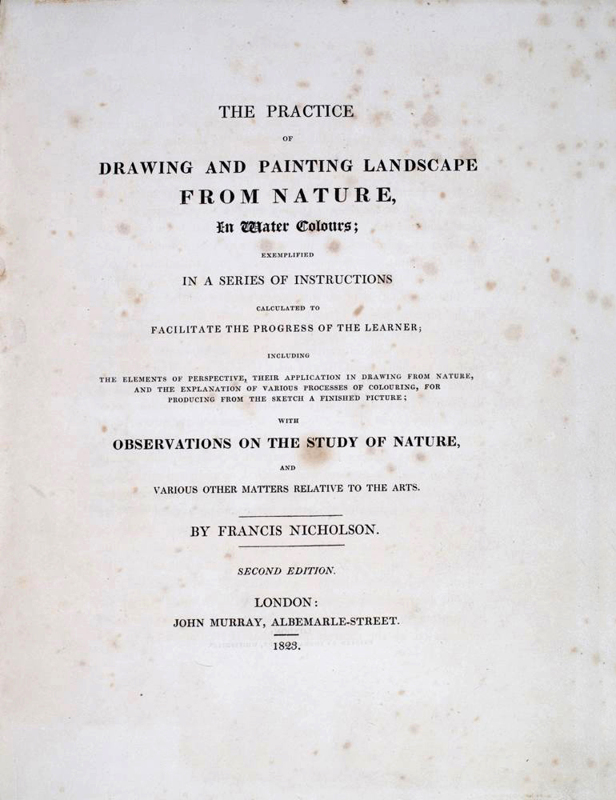
The Practice of Drawing and Painting Landscape from Nature, in Water Colours: Exemplified in a Series of Instructions calculated to facilitate the Progress of the Learner
Nicholson, Francis (1753-1844), watercolour painter and teacher. He received lessons from a German artist, Conrad Martin Metz. Nicholson had a number of patrons, including; John Stuart, first marquess of Bute, Walter Fawkes of Farnley Hall, and Sir Henry Tuite and his wife. He also had a considerable teaching practice which included ladies of fashion. His contemporary reputation was such that drawings were fraudulently sold as being by Nicholson within his own lifetime. (ODNB).



- Published
- London: John Murray, 1823.
- References
- Abbey Life 162; Prideaux p. 199
- Plates
- 4
- Binding/Size
- M=4to
- Value
- 0-5000
- Published
- London: John Murray, 1823.
- Ref
- 603
4to pp. xi 118 [2] 14 lithographic plates by C. Hullmandel (3 double-page; 1 with contemporary hand-colouring); occasionally a little spotted or foxed; later green cloth boards; spine and upper board lettered in gilt; a little rubbed. Signed in pencil: "Fred J. Thompson" to a prelim. The second edition was rewritten and much expanded with extra plates over the first edition of 1820. Nicholson, a founding member of the Water-colour Society, moved intensively into lithography at a comparatively early date and had 'much influence on the advancement of the art' (see Twyman Lithography 1800-1850 passim) Coloured plates in order: 1. Figs 1-4 show the processes in colouring, in the 'laying down' or the 'graduation' of the respective colours to achieve the final appearance. Fig 1 shows the wash of indigo in the clear part of the sky and the lightest tint of grey in the clouds &c. Fig 2 shows the shadows of the clouds and the whole of the distance with grey a little more robust, and be the correct depth for the lights of the distant mountains. Fig 3 shows general tinting being applied to the plate as a whole. Fig 4 shows the finished plate with all tints and colours adequately applied.
