If you would like to get in touch, please feel free to contact: email hidden; JavaScript is required
Browse collection
- Full collection
- 18th Century & earlier
- Ackermann
- Africa
- Alken
- Animals
- Arabasia
- Architecture/Mansions
- Art
- Australasia
- Botany
- British Isles
- Caricatures
- Children
- China
- Chromo added colour
- Chromolithographs
- Conchology
- Costume
- Cruikshank
- Culture/Lifestyle
- Dutch
- East European
- Far East
- France
- Furniture/Antiques
- General
- Germany
- Grandville
- Heraldry
- History
- History - England
- History - Europe
- Holy Land
- India
- India - sepia
- Islam
- Italy
- Japan
- Literature
- London
- Manuscript
- Map
- Military
- Monnier
- Natural history
- Pastimes
- Pochoir
- Polar regions
- Portraits
- Religious/Christian
- Religious/other
- Rowlandson
- Russia
- Science
- Scrapbook
- Sepia
- South America
- Sports/Hunting
- Stamps
- Swiss
- The Americas
- Theatre
- Travel/Scenery
- Watercolours
- World
ALEXANDER, William.
The Costume of the Russian Empire. Costumes de l'empire de Russie...
The plates of this work were copied from a collection executed by Johann Gottlieb Georgi, according to the wishes of Catherine II, and published in Saint Petersburg by Müller between 1776 and 1780. Georgi (1729-1802) was one of the scholars attached to the court of the Empress, he was the first to undertake an ethnographic study of Great Russia. There are thus twenty plates relating to the nations which draw their origins from the Finns; twenty-two figures of the different hordes of Tartars subjected to Russia; the others refer to the tribes of Samoyeds, those who inhabit the most eastern part of Siberia, as well as the tribes of Kalmouks and Mongols. The descriptions, for their part, come in particular from the work published by Müller, Descriptions of all the Nations of the Empire of Russia, from the Voyage of Siberia by D Auteroche, or from the Description of Kamtchatka by Kracheninnikow.




- Published
- London: W. Miller, Old Bond Street, 1803.
- References
- Bobins I 179; Lipperheide 1342; Abbey Travel I 244; Colas 702; Prideaux p.317;
- Plates
- 73
- Binding/Size
- M=4to
- Value
- 0-5000
- Published
- London: W. Miller, Old Bond Street, 1803.
- Ref
- 532
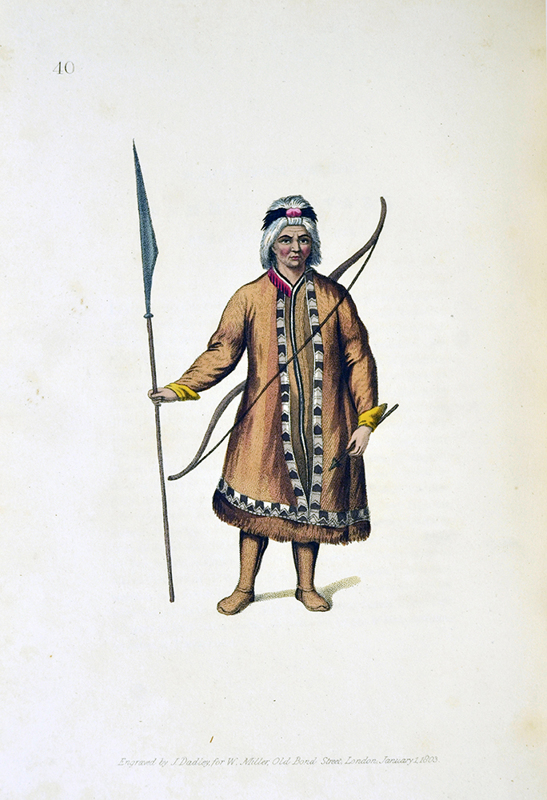
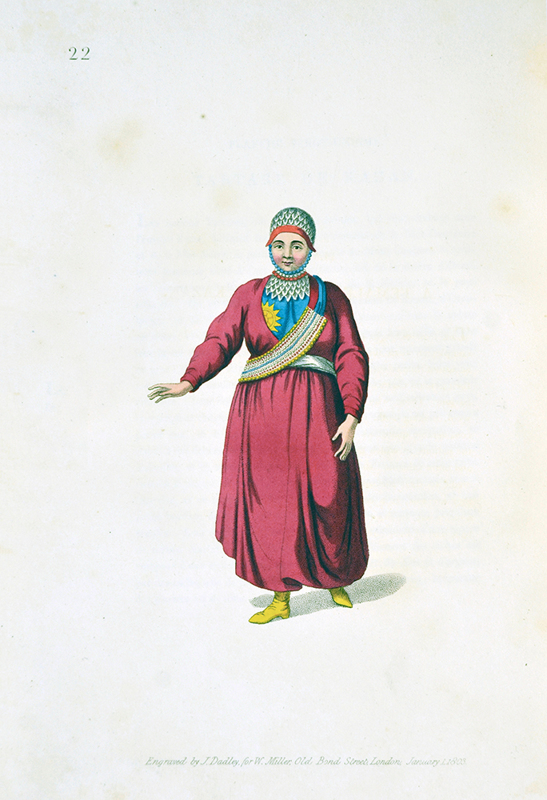
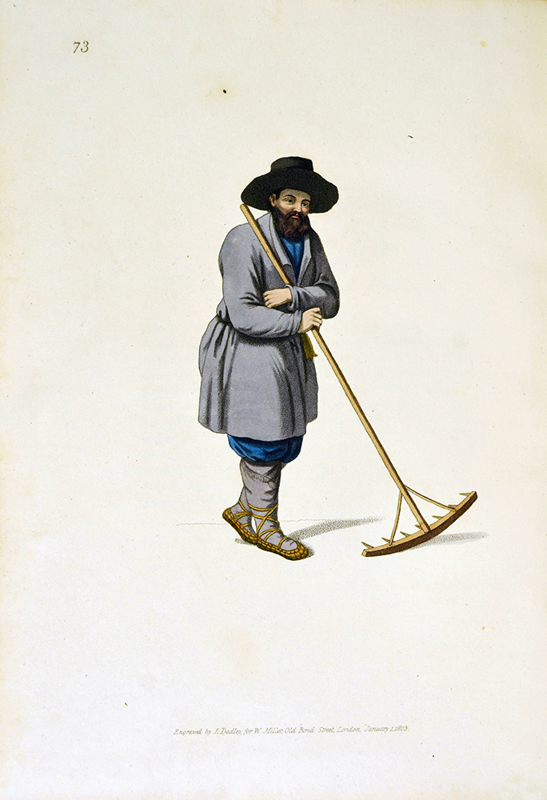
FIRST ISSUE. Large 4to (35.5 x 27 cm) [9] ll. including French and English title pages; dedications; prefaces and tables of contents with 73 hand-coloured aquatint plates numbered and engraved by J. Dadley. Each with two pages of accompanying text in English and French; text and plates watermarked 1796 original tissue guards; occasional light spotting. Contemporary red straight-grained morocco boards with dark blue morocco inlay; border and gilt floral and Greek key borders; spine with raised bands, richly gilt in compartments; gilt lettering to second compartment; gilt roulette to board edges and turn-ins red edges; marbled endpapers; slightly rubbed. Provenance: A. J. Swagne 1884 (MS inscription to upper fly-leaf). Superbly bound copy of the first issue of this popular work with plates and text watermarked 1796: a very early version. As the preface explains, this title was the third in the series of costume books issued by William Miller after Turkey and China. The costumes were drawn after Georgi and Mueller, William Alexander wrote the English text. One of the main texts available at the time on Russia: Pallas Chappe d'Auteroche Krashenenikov Sauer... The present edition contains one more costume plate than the work by his contemporary Harding, who was probably a competitor. Despite the text being shorter, the plates are also more refined in design compared with those of Harding. Coloured plates in order: 1. A Laplander. 2. A Female Inhabitant of Lapland. 3. A Peasant of Finland. 4. A Female Peasant of Finland. 5. A Woman of Finland. 6. A Woman of Esthonia. 7. An Esthonian Girl. 8. A Female Peasant of Ingria. 9. A Tcheremhisian Woman. 10. Back of a Tcheremhisian Woman. 11. A Tcheremhisian Woman, in her summer dress. 12. A Tchouvashian Female. 13. A Female Mordvine. 14. A Female Mordvine, shewing the back part of her dress. 15. A Mordvine of the Mokshan Tribe. 16. An Old Mordvine Woman of the Mokshan Tribe. 17. A Votiakian Woman. 18. An Ostiak, of the Obe. 19. An Ostiak, in his winter hunting dress. 20. A Female Ostiak. 21. A Tartar of Kazan. 22. A Female Tartar of Kazan. 23. A Female Tartar of Kazan, shewing the back part of her dress. 24. A Female Tartar of Tchatska. 25. A Female Tartar of the Nagai Tribe. 26. A Kabardinian. 27. A Kabardinian Woman. 28. A Boukharian of Siberia. 29. A Bashkirian Woman. 30. A Mestscherakian Woman. 31. A Barabinzian Woman. 32. A Barabinzian Girl. 33. A Kirghi on Horseback. 34. A Female Kirghi. 35. A Female Katchintzian Tartar. 36. A Female Schaman. 37. A Female Schaman, shewing the back part of her dress. 38. A Female Tartar, of the Tribe of Teleouti. 39. A Female Tartar, of the Teleouti Tribe, shewing the back part of her dress. 40. A Yakouti Tartar. 41. A Female Yakouti. 42. An Unmarried Female Yakouti. 43. A Samoyed. 44. A Female Samoyed. 45. A Female Samoyed, in her summer dress. 46. A Tungoose. 47. A Schaman of the Tungoosi. 48. An Inhabitant of Kamtshatka, in his winter dress. 49. A Female of Kamtshatka, in her common dress. 50. A Female of Kamtshatka, with her child. 51. A Woman of Kamtshatka, in her best dress. 52. A Schaman of Kamtshatka. 53. A Koriak. 54. A Koriak, in his dress of ceremony. 55. A Female Koriak. 56. A Woman of Tschutski, in her common dress. 57. A Woman of Tschutski, preparing skins. 58. An Aleutian. 59. A Kurilian. 60. A Kalmuk. 61. A Female Kalmuk. 62. A Female Bratzkiye. 63. A Bratzkian Woman, of Udinskoi Ostrog. 64. A Bratzkian Schaman, or female magician. 65. A Mongole Woman. 66. A Mongole Priest, or Lama. 67. A Mongloe Schaman. 68. A Merchant of Kalouga. 69. A Woman of Kalouga, in her summer dress. 70. A Merchant's Wife of Kalouga, in her winter dress. 71. An Unmarried Female of Waldai. 72. A Married Oman of Waldai. 73. A Russian Peasant.