
If you would like to get in touch, please feel free to contact: email hidden; JavaScript is required
Browse collection
- Full collection
- 18th Century & earlier
- Ackermann
- Africa
- Alken
- Animals
- Arabasia
- Architecture/Mansions
- Art
- Australasia
- Botany
- British Isles
- Caricatures
- Children
- China
- Chromo added colour
- Chromolithographs
- Conchology
- Costume
- Cruikshank
- Culture/Lifestyle
- Dutch
- East European
- Far East
- France
- Furniture/Antiques
- General
- Germany
- Grandville
- Heraldry
- History
- History - England
- History - Europe
- Holy Land
- India
- India - sepia
- Islam
- Italy
- Japan
- Literature
- London
- Manuscript
- Map
- Military
- Monnier
- Natural history
- Pastimes
- Pochoir
- Polar regions
- Portraits
- Religious/Christian
- Religious/other
- Rowlandson
- Russia
- Science
- Scrapbook
- Sepia
- South America
- Sports/Hunting
- Stamps
- Swiss
- The Americas
- Theatre
- Travel/Scenery
- Watercolours
- World
IBBETSON, Julius Caesar.
Process of Tinted Drawing.
Julius Caesar IBBETSON (1759–1817) was a painter born at Scarborough on 29 Dec. 1759; the son of Richard Ibbetson, who had belonged to the Moravian community at Fulneck in Yorkshire. He painted in water-colour in the old tinted method with great success.



- Published
- London: by Julius Ibbetson, No 49, Bell Street, Paddington, c.1795.
- References
- Dobay III p. 1167 (mentioning only eight engravings); UCBA p. 900 (no location); not mentioned in Thieme-Becker who note his other book); not in the V&A; OCLC locates one copy only at Harvard
- Plates
- 11
- Binding/Size
- M=4to
- Value
- 0-5000
- Published
- London: by Julius Ibbetson, No 49, Bell Street, Paddington, c.1795.
- Ref
- 625
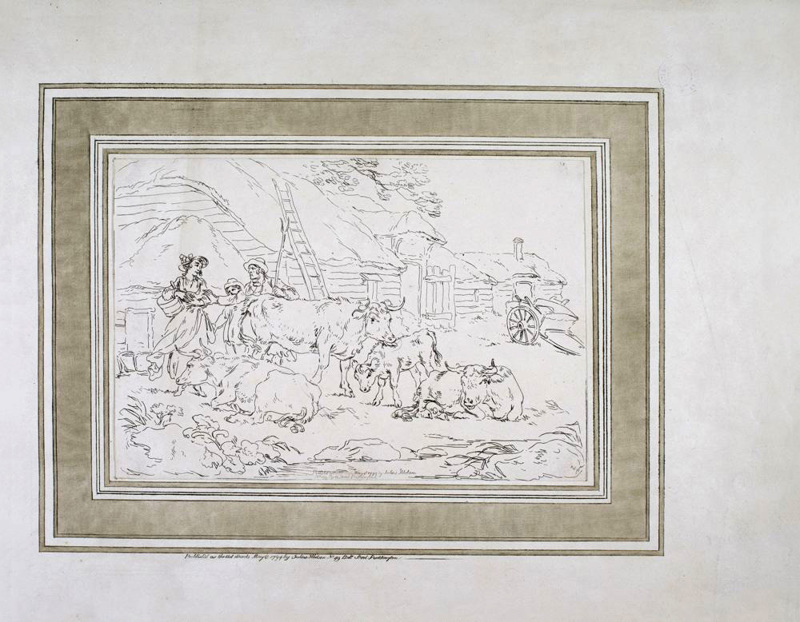
FIRST EDITION. Oblong folio three plates including the colour scheme plate the other two in five states each ranging from outline over added aquatint and wash to hand-coloured by the artist himself all 11 plates on mounts and surrounded by frames in olive-grey wash tissue guards preserved; mounts occasionally a little spotted. Slightly later half Russia over marbled boards front cover with gilt-stamped lettering-piece; extremities are worn re-backed; corners reinforced, fresh inner cloth hinges; from Cheltenham Public Library who sold books some 15 years ago. The landscape and watercolour painter Julius Caesar Ibbetson (1759-1817) prepared this book which exemplifies step-by-step the creation of a fully coloured engraving with aquatint areas for graphic artists, watercolourists, and amateurs. It is his first book which came out after he had moved to Paddington in November 1794. 'Conscious of the fact that he had succeeded as a professional artist without the benefit of instruction at the hands of another Ibbetson was anxious to prove to aspiring amateurs that a formal training was not always necessary to becoming a competent painter ... Through his empirical approach and subsequent mastery of the subject Ibbetson was well-placed to reveal the secrets of his profession to laymen. A Process of Tinted Drawing published in 1795, was his first book and explained the use of watercolours. This was his predominant medium, and he restricted himself to muted blues, greens and greys applied in thin washes ... This use of three tones is the book's main premise and in its preoccupation with colour foreshadows the publication in 1803 of An Accidence or Gamut of Painting in Oil ... '(James Mitchell, Julius Caesar Ibbetson ... 'The Berchem of England' pp. 45-6) *Rebinding and restoration work on this book was carried out by Ron Norman of Hartlepool. (Ronnorm@aol.com)* Plates in order: 1. Ink sketch only of a Farmyard scene. 2. Same scene, but now with sepia overlay. 3. Same scene with more depth and shade to drawing. 4. Same scene with more shading and detail added. 5. Same scene, but now finished with the full complement of colours. 6. Ink sketch of a family cooking a meal by the roadside and people riding or walking beside a donkey. 7. Same scene, but now with some sepia overlay. 8. Same scene, but now with some depth and shading. 9. Same scene with more background added and final shading and detail. 10. Same scene, but now with the full complement of colours added. 11. A Colouring Guide.


