If you would like to get in touch, please feel free to contact: email hidden; JavaScript is required
Browse collection
- Full collection
- 18th Century & earlier
- Ackermann
- Africa
- Alken
- Animals
- Arabasia
- Architecture/Mansions
- Art
- Australasia
- Botany
- British Isles
- Caricatures
- Children
- China
- Chromo added colour
- Chromolithographs
- Conchology
- Costume
- Cruikshank
- Culture/Lifestyle
- Dutch
- East European
- Far East
- France
- Furniture/Antiques
- General
- Germany
- Grandville
- Heraldry
- History
- History - England
- History - Europe
- Holy Land
- India
- India - sepia
- Islam
- Italy
- Japan
- Literature
- London
- Manuscript
- Map
- Military
- Monnier
- Natural history
- Pastimes
- Pochoir
- Polar regions
- Portraits
- Religious/Christian
- Religious/other
- Rowlandson
- Russia
- Science
- Scrapbook
- Sepia
- South America
- Sports/Hunting
- Stamps
- Swiss
- The Americas
- Theatre
- Travel/Scenery
- Watercolours
- World
GAVARNI, Paul [pseud of Guillaume Sulpice Chevallier]
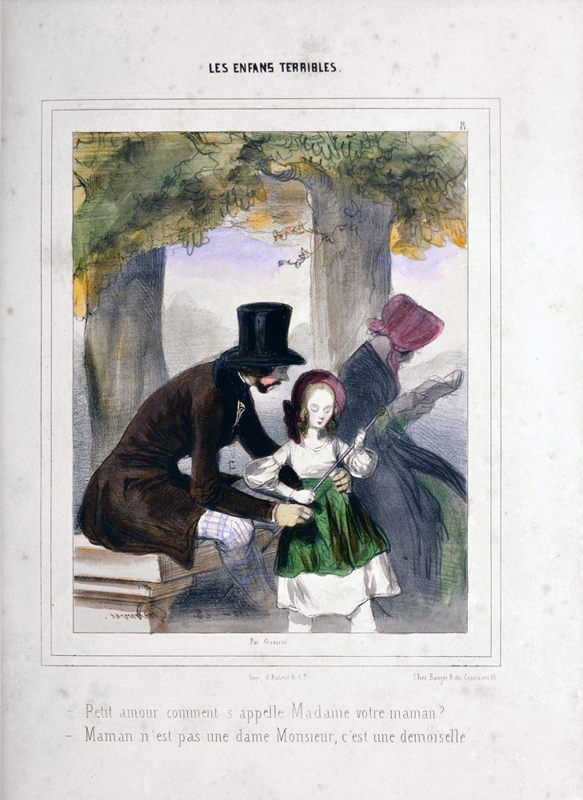
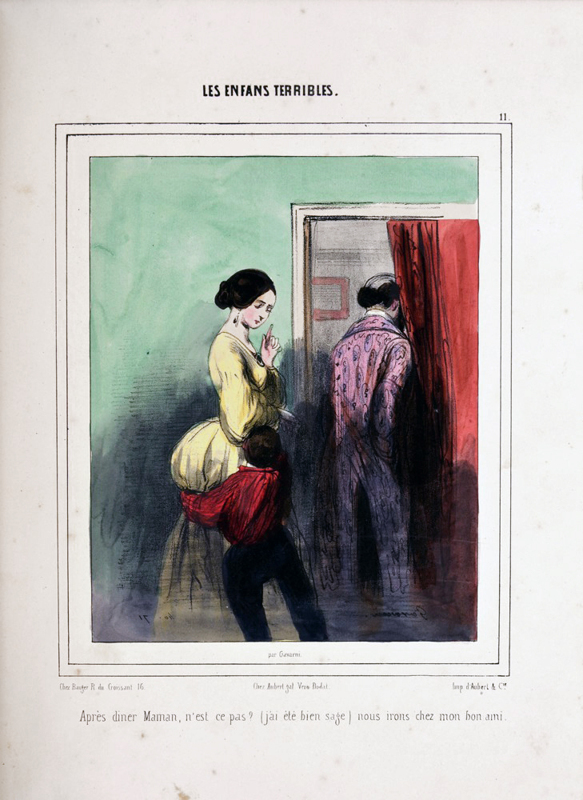
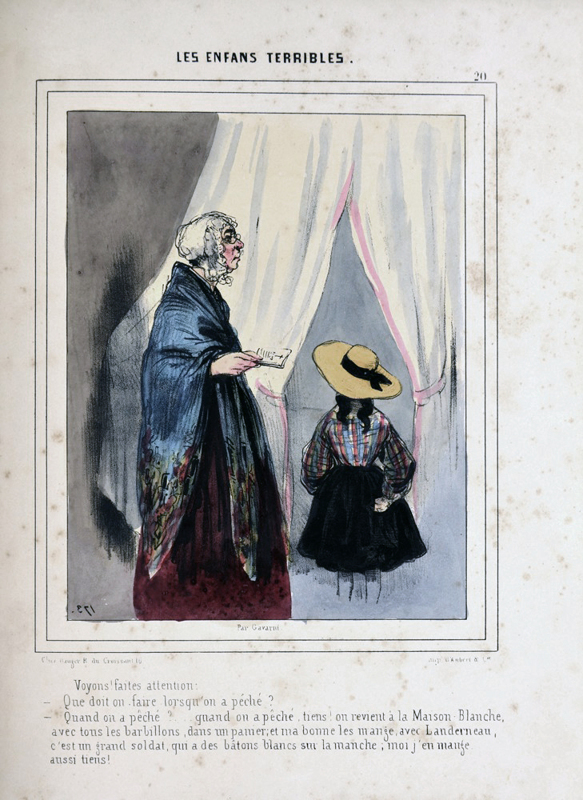
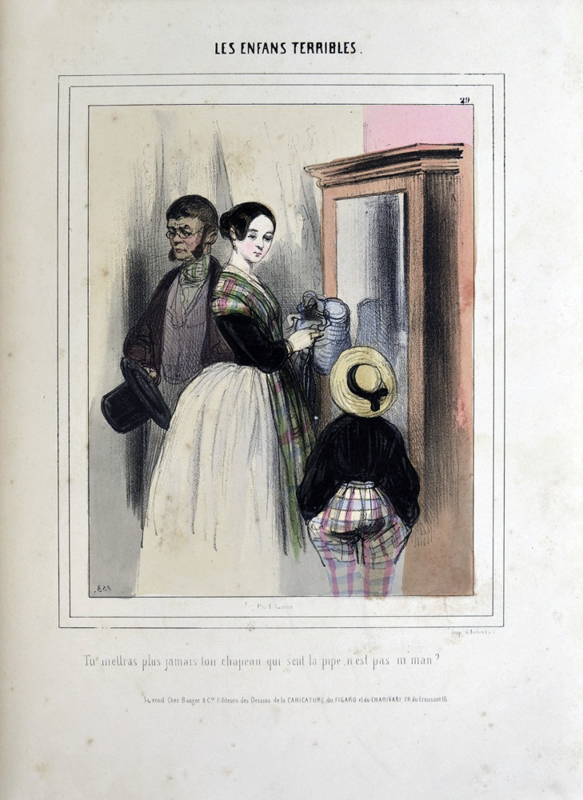
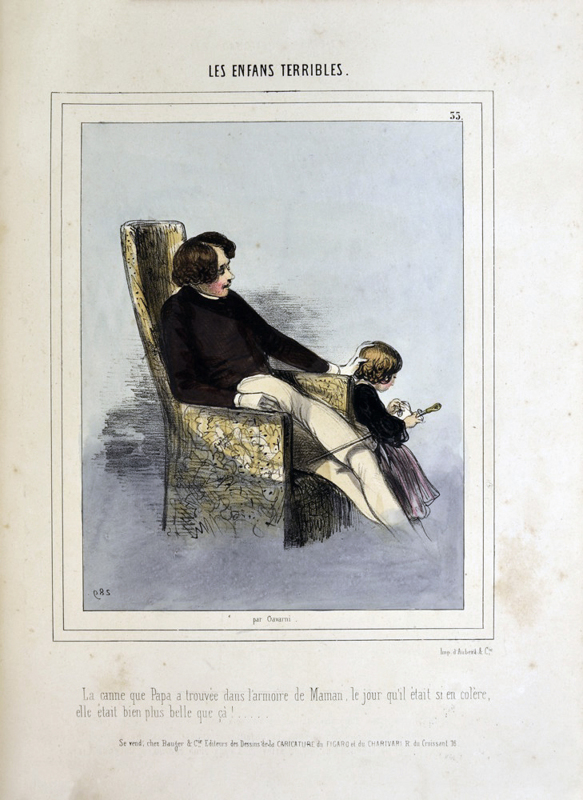
Les Enfans terribles.
This series was originally published in Le Charivari newspaper in 1844. Paul Gavarni was the nom de plume of Sulpice Guillaume Chevalier (born 1801 or 1804 in Paris; died 1866), a French caricaturist, water colorist and lithographer. "What will make Gavarni's work imperishable: this intense life, this deep knowledge of humanity. It was also around the same time that he imagined a type that has remained proverbial: the enfant terrible who, naively indifferent to the cataclysms he can unleash, always reveals what should be ignored, tells what should be It was an amusing and new idea to show the ferocious selfishness of these little monsters, quiet and smiling in their unconsciousness. It is true that, under the pencil of the artist, they are so funny that one ends up by smiling instead of pitying their victims; victims whom, moreover, the philosopher took pleasure in making unsympathetic next to these childish tyrants.... This series of drawings stems directly from his beautiful studies of children of 1834; and, however, while keeping the qualities of these, shows well, by freer, more daring, more cursive drawing, all the way covered." (Lemoisne)


- Published
- Paris: n.d., [1838-1842]
- References
- Ray; The Art of the French Illustrated Book 152.
- Plates
- 49
- Binding/Size
- M=4to
- Value
- 0-5000
- Published
- Paris: n.d., [1838-1842]
- Ref
- 261
Large quarto (12 15/16 x 9 13/16 inches; 329 x 250 mm.). Forty-nine numbered hand-colored lithographed plates heightened with gum arabic. With 8 pp. publisher's advertisements (Aubert et Cie Éditeurs) at end. Bound without the hand-colored lithographed title. Imprints vary (plate 1 has imprint: Edite par le Charivari; plates 2-5 have imprint: Au Bureau du Charivari; plates 6-13 15-24 and 38-43 have imprint: Chez Bauger; plates 14 and 44-49 have imprint: Chez Bauger & Cie.; plates 26-37 have imprint: Se vend chez Bauger & Cie. Editeurs des Dessins de la Caricature du Figaro et du Charivari; plates 11 44 47 and 49 have additional imprint: Chez Aubert; and plate 25 has no imprint). Plates printed by Aubert & Cie. Contemporary navy blue vertically-ribbed cloth, lettered in gilt on front cover. Some rubbing and wear to cloth, small strip of cloth neatly reattached at upper edge of rear board front hinge expertly repaired. Some foxing a few plates slightly browned small dampstain to upper blank corner of Plate 1 and to lower blank margin of advertisements at end. A very good copy.Gavarni's conception of the enfant terrible has passed into a proverb. For all their apparent ingenuousness his appealing children are preternaturally sharp. They see and hear everything in their little world and they are infallible in announcing their discoveries where they will cause the most embarrassment. So a little boy asks a visitor: "Sir who is it that invented gunpowder?" since Papa says "it isn't you" (no. 10); or a little girl informs a suitor: "Aunt Amelia says that you are very nice; but it's a pity that you are too stupid" (no. 32) (Ray The Art of the French Illustrated Book). As the historical antecedent to Dennis the Menace and Calvin and Hobbes Les Enfants terribles was far more incisive and revealing in its social commentary. In its images Gavarni regularly uses the quasi-innocent questions or remarks of children to put the world of the adults around them in disarray. The subject is more often than not the marital or extra-marital situations of the grown-ups" (Beatrice Farwell; The Charged Image p. 91). Coloured plates in order: 1. "J'ai a,ssez vu mon cousin, moi! M' man viens tu t en?" 2. "Adieu Madame, a bientot puisque vous permettez que je vienne..." 3. "Petit Cherubin, j'ai apporte du bonbon pour vous..." 4. "Monsieur! N'est ce pas que ca n'est pas vrai, quevous n'avez par les Cheveux peints?" 5. "Oh! C'est vrai! T'as les yeux comme les lanternes de ton cabriolet..." 6. "Grand Papa sa fiche de petit maman, parceque petite Maman s'est fait des tetais avec du coton, na!" 7. "Mere! Est-ce que c'est le creve de ce matin que t'as dit que ca serait toujours..." 8. "Petit amour comment s'appelle Madame votre maman?..." 9. "Maman va venir pas tout de suite elle est avec Madame Pelet..." 10. "Qu'est-ce donc la inventee la poudre, Monsieur?...que papa dit que ce n'est pas vous" 11. "Apres diner Maman, n'est ca pas? (j'ai ete bien sage) nous irons chez mon bon ami" 12. "N'est- ce pas, ma mere, que c'est bien vilam de dire: vous m'embetez?..." 13. "Quand Maman aime bien petit Papa, elle appelle petit Papa 'ma niniche' " 14. "La rose que vous donnee a Maman? Ah oui, oui...que vous avez manque de vous casser le cou pour l'avoir?..." 15. "N'est pas, Maman, que le petit peigne a moustaches..." 16. "Maman! Maman! ce Monsieur du Luxembourg que tu as dit (tu sais bien) que c'etait nn grand ami de Papa!....." 17. "Est ce que c'est vrai Monsieur le Marquis que vous etes toujours toujours..." 18. "C'est vous qu'etes le grand sec qui vrient toujours pour diner? Monsieur, Papa n'y est pas" 19. "Ils t'on dit jouer que tu voudras dans la salle a manger?..." 20. Voyons faites attention: "Que doit on faire lorsqu'on a peche?" "Quand on a peche?..." 21. "Monsieur Albert? C'est un monsieur du Jardin-des-Plantes..." 22. "Houp! Houp! papa...ah! Mais tu ne fais si bien la cheval..." 23. "Mais pourquoi donc, Mosieu Bachu..." 24. "Le spectacle etait-ce bien? Et a-t-il ete raisonnable Lolo?..." 25. "Ma bonne bisque, va M'man, de se lever comme ca de bonne heure..." 26. "Que tu es donc godiche, Tomon, de venir tous les matins..." 27. "Maman c'est Mosieu...tu sais, ce Mosieu qui a ce nez" 28. "Maman dit que vous savez tous les secrets de Polichimelle..." 29. "Tu mettras plus jamars ton chapeau..." 30. "Je le dirai....que t'as encore pris dans le petit pot du rouge..." 31. "Papa, empeche donc Francoise de se moquer toujours de moi..." 32. "Ma tante Amelie dit que t'es bien gentil..." 33. "Tu ne sais pas? Petit Papa...cet animal de Maurice..." 34. "Ma tante Aurelie qui distait l'autre jour a Maman..." 35. "La canne que Papa a trouvee dans l'armoire de Maman..." 36. "Tu ne sais pas la lecon ta tante va venir..." 37. "Est-ce que c'est vrai, Mosieu d'Alby..." 38. "Si tu touches encore a la bouteille du vin muscat..." 39. "Un petit de la pension qui disait que t'etais renegat..." 40. "Est-ce que vous payez des impositions comme papa..." 41. "Mosieu, on ne peut pas voir papa, il est en train de faire faillite" 42. "Cette madame de Lieusaint est-elle bete!..." 43. "Dis-donc Miroux...dis donc Miroux....dequoi donc que madame..." 44. "Papa voila ton homme de paille" 45. "Mosieu Belassis, moi j'ai pas des jambes en manches de veste" 46. "Decidement mon cher ami..." 47. "M'man n'y est pas parce que tu rentres avant cinq heurs..." 48. "N'est-ce pas, Mosieu Prud homme, qu'il ne faut pas..." 49. "Maman a ecrit mosieu Prosper et Papa a vu la lettre..."