If you would like to get in touch, please feel free to contact: email hidden; JavaScript is required
Browse collection
- Full collection
- 18th Century & earlier
- Ackermann
- Africa
- Alken
- Animals
- Arabasia
- Architecture/Mansions
- Art
- Australasia
- Botany
- British Isles
- Caricatures
- Children
- China
- Chromo added colour
- Chromolithographs
- Conchology
- Costume
- Cruikshank
- Culture/Lifestyle
- Dutch
- East European
- Far East
- France
- Furniture/Antiques
- General
- Germany
- Grandville
- Heraldry
- History
- History - England
- History - Europe
- Holy Land
- India
- India - sepia
- Islam
- Italy
- Japan
- Literature
- London
- Manuscript
- Map
- Military
- Monnier
- Natural history
- Pastimes
- Pochoir
- Polar regions
- Portraits
- Religious/Christian
- Religious/other
- Rowlandson
- Russia
- Science
- Scrapbook
- Sepia
- South America
- Sports/Hunting
- Stamps
- Swiss
- The Americas
- Theatre
- Travel/Scenery
- Watercolours
- World
NUS, Eugene.
Antony Meray.
L'Empire des Legumes Droleries Vegetables.
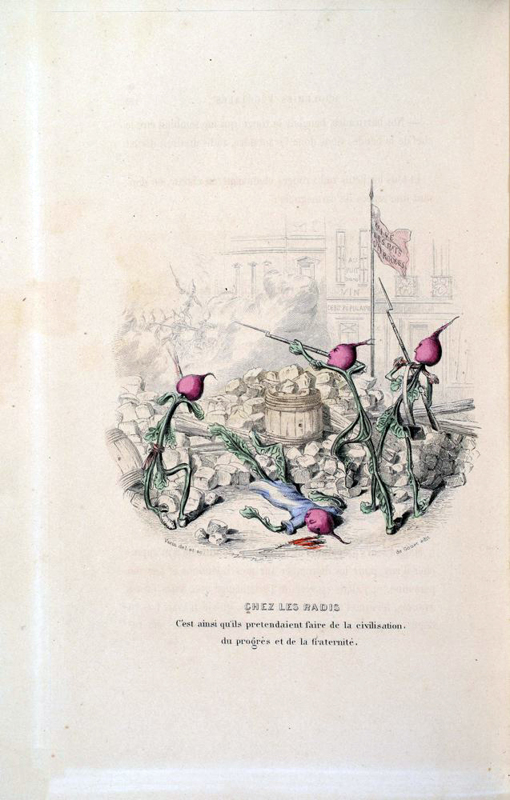
The work is Drôleries végétales (Vegetable Drolleries), also known as L'Empire des légumes (The Empire of the Vegetables). It was originally published in Paris in 1851; It contains two dozen steel-engraved plates in the style of J.J. Grandville, whose better-known 'Les fleurs animées' from 1847. The humorous text is by Eugène Nus and Antony Méray, and the plates were drawn and engraved by Amédée Varin (1818-1883), a French illustrator and engraver who had also worked on the Fleurs animées, assisting the credited engraver Charles Geoffroy. In a tradition that can be traced back to the animal fables of Aesop, the work presents a satirical view of humanity and its follies, as reflected in the goings-on among the denizens of the vegetable kingdom ... or "Empire," as it is called here.


- Published
- Paris: Edouard Blot, 1861.
- References
- Carteret III, 218. Brivois 134-5. Vicaire VI, 245. Sander 537. Not in Ray
- Plates
- 25
- Binding/Size
- M=4to
- Value
- 0-5000
- Published
- Paris: Edouard Blot, 1861.
- Ref
- 1006
[The Empire of the Vegetables] Three-quarter green morocco with twin gilt fillets over marbled boards; spine with raised bands in blind; repeat gilt devises to each compartment; lettered in gilt to the second; top edge gilt; marbled endpapers; corners bumped; spine lightly rubbed and worn; illustrated with a hand coloured frontispiece and 24 hand-coloured plates, a tall copy (28.5 x 20 cm). A rare work. The plates are by Amedee Varin, who also illustrated Les Papillons Metamorphoses... the book with plates in the style of Grandville. A delicately hand-coloured copy of the "Droleries Végétales," a masterpiece of nineteenth-century French book-illustration in the style of Grandville. The twenty-four steel engraved plates depict various kinds of vegetables, including carrots, radishes, onions, beans, and lettuce, that begin to walk and talk; several of these anamorphic beings begin to assume human traits, with hilarious results. Witness the asparagus and artichoke fighting ("For too long we have been put in the same sauce; it is finally time to put our foot down!") or the Parliamentary Carrot ("Three hours on the witness stand without cracking"). The fine plates by Amédée Varin (1818-1883) and brilliantly conceived and executed. Coloured plates in order: 1. Frontispiece. 2. Cucurbitus 1st. Costume d'apparat. 3. Un Ministre de Cucurbitus. 4. Comme quoi les enfants viennent sous les choux. 5. Conseil de Cucurbitus 1st. 6. Bapteme de Deux Romaines. Trop piquantes pour les uns et trop douces pour d'autres. 7. Les Romaines. 8. Carotte Conjugale. 9. Bourgeois de Paris en partie fine. 10. Les Extremes se Touchent. 11. Une Insurrection. Depuis trop long-temps nous sommes soumis aux memes sauces il est l'heure enfin de mettre les pieds dans le plat. 12. Un Menage Orageux. 13. Ils etaient calmes et priant quand la panique vint au chef. 14. Carotte Parlementaire, trois heures sans cracher. 15. Ses adulateurs finirent par le devorer. 16. Appel aux Flageolets. 17. Le Choux dez Bruxelles. Personnage historique en Brabant. 18. Une Carotte Reputee Peu Honnete. 19. Chez les Radis. L'exces de boisson les faisaient chanceler et leur rendaient la tete ereuse. 20. Chez les Radis. C'est ainsi qu'ils pretendaient faire de la civilisation du progres et de la fraternite. 21. Carotte Domestique. 22. Chez les Radis. On l'appelait honnete et modere. 23. L'Asperge Hative. 24. La soupe aux choux se fait dans la marmite. 25. Un Baladin en campagne.