
If you would like to get in touch, please feel free to contact: email hidden; JavaScript is required
Browse collection
- Full collection
- 18th Century & earlier
- Ackermann
- Africa
- Alken
- Animals
- Arabasia
- Architecture/Mansions
- Art
- Australasia
- Botany
- British Isles
- Caricatures
- Children
- China
- Chromo added colour
- Chromolithographs
- Conchology
- Costume
- Cruikshank
- Culture/Lifestyle
- Dutch
- East European
- Far East
- France
- Furniture/Antiques
- General
- Germany
- Grandville
- Heraldry
- History
- History - England
- History - Europe
- Holy Land
- India
- India - sepia
- Islam
- Italy
- Japan
- Literature
- London
- Manuscript
- Map
- Military
- Monnier
- Natural history
- Pastimes
- Pochoir
- Polar regions
- Portraits
- Religious/Christian
- Religious/other
- Rowlandson
- Russia
- Science
- Scrapbook
- Sepia
- South America
- Sports/Hunting
- Stamps
- Swiss
- The Americas
- Theatre
- Travel/Scenery
- Watercolours
- World
ANON.
[Jewish Pentateuch (Torah)]
The most prominent meaning for Jews is that the Torah constitutes the first five books of the Hebrew Bible (also called the Pentateuch, 'five books' in Greek), traditionally thought to have been composed by Moses. These sacred texts are written on a scroll and kept in a synagogue.




- Published
- UNKNOWN. ca 1850
- Binding/Size
- M=4to
- Value
- 0-5000
- Published
- UNKNOWN. ca 1850
- Ref
- 1613
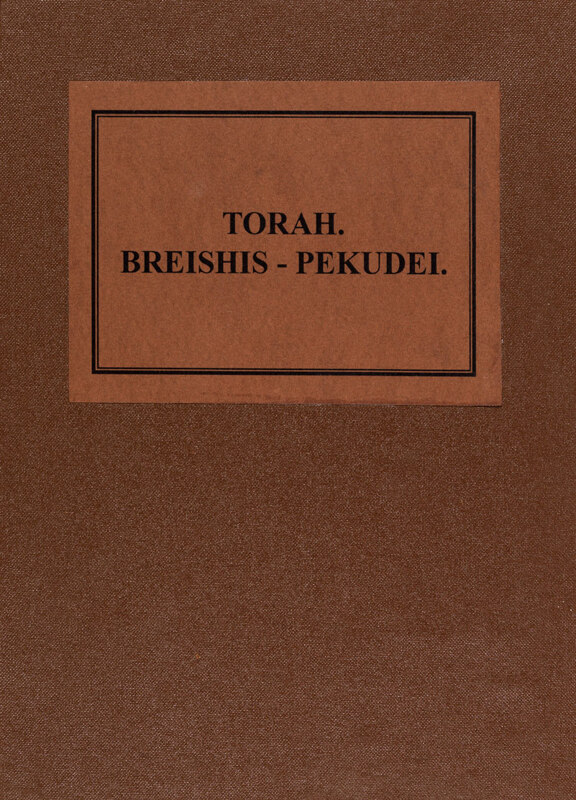
A collection of partially complete, loosely bound hand-written manuscript pages, an example of the Jewish Pentateuch or Torah. It is the type of book that worshipers might have used to follow along with the regular Torah readings in a synagogue that are traditionally read from a scroll. Many of the bound pages have ink or water stains, with uneven edges - a few have portions of page or text missing and are laid onto backing paper. The Torah is divided into 54 sections; however, this example is incomplete, and sections 24-54 are missing. This example begins at the first section, 'Breishis,' in Genesis, although the first few pages are missing. The section 'Noach' is complete up until and including section 16 'Bayishlach' - a section of Exodus. The text of section 17 'Vayishma' is correct, as are sections 18 'MIshoatim - section 19 'Terumah' - section 20 'Tetsaveh' - section 21 'Tisa' - section 22 ' Vayakhel' - section 23 'Pekudei'. The book ends here. The book's origins are uncertain. Some sections appear to have been written by several people. My best guess for a date is mid 19th century. It is now housed in a custom-made cloth-bound brown solander box to keep the fragile contents in better condition, with a title to the front cover and spine. There are no colour plates, so none are listed.


