
If you would like to get in touch, please feel free to contact: email hidden; JavaScript is required
Browse collection
- Full collection
- 18th Century & earlier
- Ackermann
- Africa
- Alken
- Animals
- Arabasia
- Architecture/Mansions
- Art
- Australasia
- Botany
- British Isles
- Caricatures
- Children
- China
- Chromo added colour
- Chromolithographs
- Conchology
- Costume
- Cruikshank
- Culture/Lifestyle
- Dutch
- East European
- Far East
- France
- Furniture/Antiques
- General
- Germany
- Grandville
- Heraldry
- History
- History - England
- History - Europe
- Holy Land
- India
- India - sepia
- Islam
- Italy
- Japan
- Literature
- London
- Manuscript
- Map
- Military
- Monnier
- Natural history
- Pastimes
- Pochoir
- Polar regions
- Portraits
- Religious/Christian
- Religious/other
- Rowlandson
- Russia
- Science
- Scrapbook
- Sepia
- South America
- Sports/Hunting
- Stamps
- Swiss
- The Americas
- Theatre
- Travel/Scenery
- Watercolours
- World
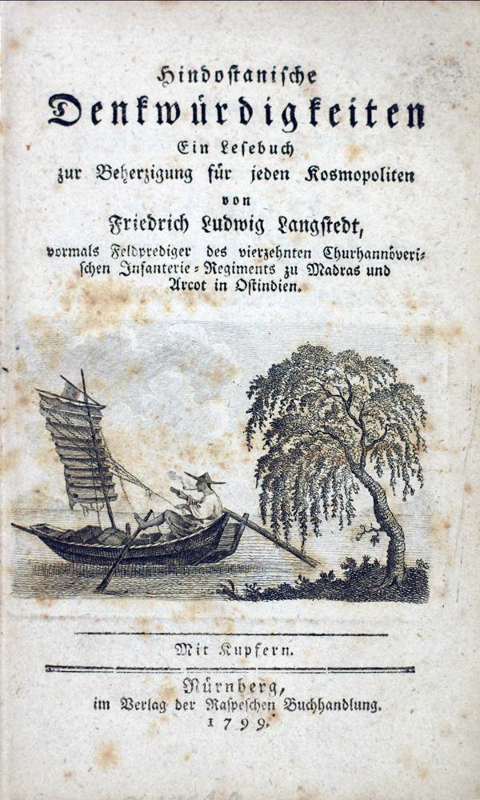
LANGSTEDT, Friedrich Ludwig.
Hindostanische Denkw.
Friedrich Ludwig Langstedt (1750-1804) was a botanist and naturalist. He was the chaplain of a Hanoverian regiment sent to southern India in 1782 as auxiliary troops for the British East India Company. After some years of service in the Madras region, he returned to Germany and became an English teacher and writer.




- Published
- Nuremberg: Raspe, 1799.
- References
- Not in Stafleu, nor Hunt, Pritzel, Nissen, BBI or Colas; KVK: 3 copies; NCC: 1 copy; not in NUC
- Plates
- 8
- Binding/Size
- S=8vo
- Value
- 0-5000
- Published
- Nuremberg: Raspe, 1799.
- Ref
- 212
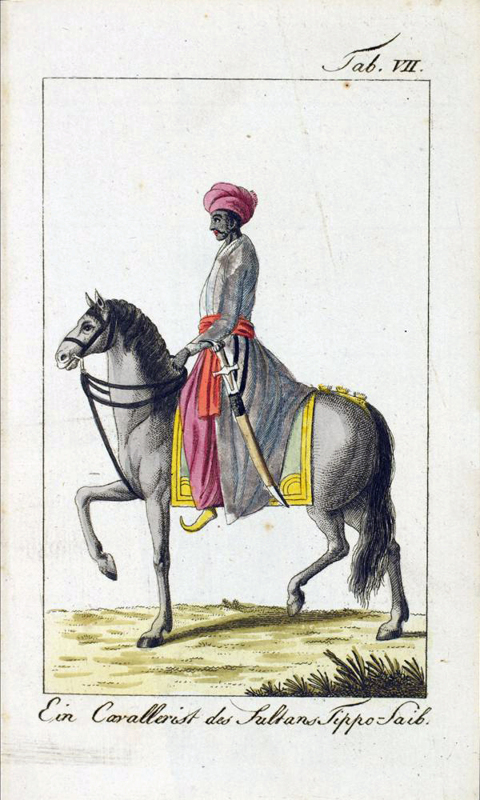
8vo. Half cloth. With an engraved view on the title and eight engraved plates in contemporary hand-colouring. XXIV, 392, (4) pp. Scarce interesting work on India by the German theologian and botanist Friedrich Ludwig Langstedt (1750-1804), who accompanied the Hanoverian infantry to India as an army chaplain in Madras and Arcot. The present work describes the wild plants and animals of India, also containing a herbal (pp. 88-135), the farming, domestic animals, arts and crafts of India, education, Indian art, and sightseeing places, with at the end eight fine hand-coloured plates of Indian soldiers and coaches, made by G. Vogel from Nürnberg. Coloured plates in order: 1. Ein Armenischer Christ in Ostindien. 2. Ein Malabarischer Gotzenwagen. 3. Ein Malabarischer leichter Wagen, Haekry genannt. 4. Ein Ostindischer - Fragesessel, Palankin genannt. 5. Ein Bengalischer Sipay. 6. Ein Karnatischer Sipay, oder Landsoldat. 7. Ein Cavallerist des Sultans Tippo-Saib. 8. Ein Infanterist des Mysorischen Sultans Tippo-Saib.

