
If you would like to get in touch, please feel free to contact: email hidden; JavaScript is required
Browse collection
- Full collection
- 18th Century & earlier
- Ackermann
- Africa
- Alken
- Animals
- Arabasia
- Architecture/Mansions
- Art
- Australasia
- Botany
- British Isles
- Caricatures
- Children
- China
- Chromo added colour
- Chromolithographs
- Conchology
- Costume
- Cruikshank
- Culture/Lifestyle
- Dutch
- East European
- Far East
- France
- Furniture/Antiques
- General
- Germany
- Grandville
- Heraldry
- History
- History - England
- History - Europe
- Holy Land
- India
- India - sepia
- Islam
- Italy
- Japan
- Literature
- London
- Manuscript
- Map
- Military
- Monnier
- Natural history
- Pastimes
- Pochoir
- Polar regions
- Portraits
- Religious/Christian
- Religious/other
- Rowlandson
- Russia
- Science
- Scrapbook
- Sepia
- South America
- Sports/Hunting
- Stamps
- Swiss
- The Americas
- Theatre
- Travel/Scenery
- Watercolours
- World
[COSTUME]
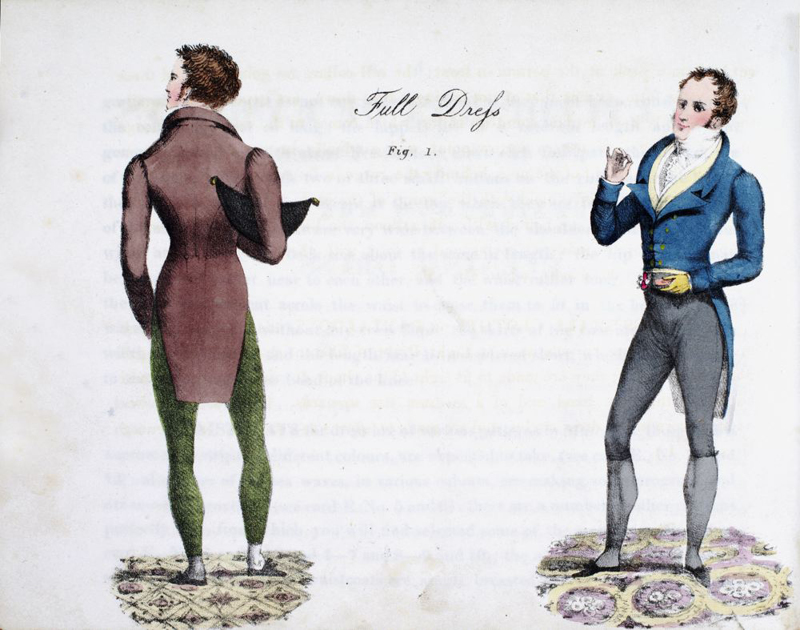
The Cyclopaedia of the British Costumes from the Metropolitan Repository of Fashions.
According to Colas this exceptionally rare costume periodical ran from 1823 to 1847 and contained 146 plates."Contains the most Fashionable Make and Cut, also the most prevailing Colors and Patterns from the various Manufactories " (text).The superb hand-colored plates depict for every season of the year, Ladies' Riding Habits; Pelisses; Dress Coats; Walking Dress Coats; Frock Coats; Riding Coats; Waistcoats; Trowsers, Pantaloons, and Breeches; Undress Trowsers; Juvenile Dresses; Children's First Dress and Military Coats, etc.




- Published
- London: W.Hearn, May 1823 - October 1827.
- References
- Colas I, 771; Hiler p.209
- Plates
- 56
- Binding/Size
- S=8vo
- Value
- 0-5000
- Published
- London: W.Hearn, May 1823 - October 1827.
- Ref
- 1294
SCARCE. Numbers 1-10 are only bound in one volume, a small oblong quarto (6.75" x 9"). Engraved general title, one hand-coloured aquatint view of the Metropolitan Repository of Fashions building, 55 hand-coloured lithographed fashion plates with images of 126 costumes by various anonymous hands, extra-illustrated with a duplicate general title bound before the start of the 7th number. Contemporary half calf over marbled paper-covered boards, the leather on the covers tooled in blind with a decorative roll tool, the flat spine divided into five compartments by gilt fillets, and an overall repeat design of various small tools. A significant portion of this charming, essential, and very rare bi-annual survey of what was fashionable in the London of King George IV, the most dandified of all the British monarchy. "A Dandy is a clothes-wearing Man, a Man whose trade, office, and existence consists of wearing clothes. Every faculty of his soul, spirit, purse, and person is heroically consecrated to this one object, the wearing of clothes wisely and well: so that the others dress to live; he lives to dress" (Thomas Carlyle). London of the mid-1820s was the world's fashion center: the proclaimed leader of the fashionable Regency-set had finally succeeded his father and been crowned King George IV at a ceremony that was "cutting-edge" in fashion terms. This final decade before the start of the Victorian era was probably the last time when men's fashions were as important (and as eye-catching) as women's. For the man-about-town, the proper cut, colour, and combination were all vital components of maintaining one's position in society. The present scarce work (no copies, sets, or partial sets are listed as having sold at auction in the past thirty-five years) was intended for the tailors and dress shops that supplied London high society, but with a decided bias: 73 of the 126 figures show men's costume (of the remainder 25 are of children and 28 women). The charming text (the perfect complement to the plates) is the work of a fashion writer at the centre of the world they are describing. The ephemeral nature of fashion means that the text has a charming immediacy "Coats, in respect to colours, the Olives and Clarets have had a tolerable run, but the Spanish Brown is expected to take," while also providing details important in the history of fashion about what cloth was used, how it was cut, the type and number of buttons and other embellishments, the way the clothes should hang - all details essential for tailors of the day, but also details which fashion plates alone cannot show and which would otherwise have been lost. The present volume is one of five that were published between 1823 and 1847, with a total of about 146 plates (according to Colas). OCLC lists a single example of this set, which was exhibited at the Smithsonian. *Rebinding and restoration work on this book was carried out by Ron Norman of Hartlepool. (Ronnorm@aol.com)* Coloured plates in order: 1. Full Dress. 2. Morning Dress. 3. Military Frock. 4. Surcoats. 5. Children's Dresses. 6. Ladies' Pelisses. 7. Ladies' Riding Habits. 8. Evening Dress. 9. Morning Dress. 10. Jockey Dress. 11. Surtout Coats. 12. Children's Dresses. 13. Travelling Cloak / Walking Cloak. 14. Ladies' Pelisses. 15. Ladies' Riding Habits. 16. Ladies' Riding Habits. 17. Ladies' Pelisses. 18. Evening Dress. 19. Morning Dress / Jockey Dress. 20. Surtout Coats. 21. Children's Dresses. 22. Cloaks. 23. Costumes: Walking & Riding. 24. Evening Dress. 25. Walking or Morning Dress. 26. Costumes: Military & Opera. 27. Costumes: Jockey & Surtout. 28. Juvenile Costumes. 29. Costumes: Walking & Riding. 30. Evening Costumes. 31. Costumes: Bedford & Morning. 32. Costumes: Military & Walking. 33. Juvenile Costumes. 34. Costumes: Surtout & Pelisse. 35. Walking Pelisses & Ladies' Riding Habits. 36. Costumes: Evening & Morning. 37. Costumes: Morning & Hunting. 38. Juvenile Dresses. 39. London; A Front View of the Metropolitan Repository of Fashions, Southampton St, Holborn. 40. Costumes: Military & Riding Habit. 41. Costumes: Pelisse & Evening. 42. Costumes: Morning & Evening. 43. Costumes: Hunting & Jockey. 44. Costumes Juvenile. 45. Pelisses. 46. Surtout Coats. 47. Breeches, Trousers, and Pantaloons. 48. Juvenile Dresses. 49. Ladies' Riding Habits and Walking Pelisses, Frock Coats & Walking Lapelled Coats. 50. Pelisse, Dress Coat, Frock Coat & Juvenile Trousers for Undress. 51. Shooting & Hunting Coats. 52. Trousers for Undress, Children's First Dress & Great Coat. 53. Ladies' Riding Habits and Walking Pelisses. 54. Undress, or Frock Coats. 55. Military Frocks & Riding Coats. 56. Juvenile Waistcoats.


