
If you would like to get in touch, please feel free to contact: email hidden; JavaScript is required
Browse collection
- Full collection
- 18th Century & earlier
- Ackermann
- Africa
- Alken
- Animals
- Arabasia
- Architecture/Mansions
- Art
- Australasia
- Botany
- British Isles
- Caricatures
- Children
- China
- Chromo added colour
- Chromolithographs
- Conchology
- Costume
- Cruikshank
- Culture/Lifestyle
- Dutch
- East European
- Far East
- France
- Furniture/Antiques
- General
- Germany
- Grandville
- Heraldry
- History
- History - England
- History - Europe
- Holy Land
- India
- India - sepia
- Islam
- Italy
- Japan
- Literature
- London
- Manuscript
- Map
- Military
- Monnier
- Natural history
- Pastimes
- Pochoir
- Polar regions
- Portraits
- Religious/Christian
- Religious/other
- Rowlandson
- Russia
- Science
- Scrapbook
- Sepia
- South America
- Sports/Hunting
- Stamps
- Swiss
- The Americas
- Theatre
- Travel/Scenery
- Watercolours
- World
SCHLATTER, Daniel.
Bruchstucke aus einigen Reisen nach dem suclichen Rubland in den Jarhren 1822-1828.
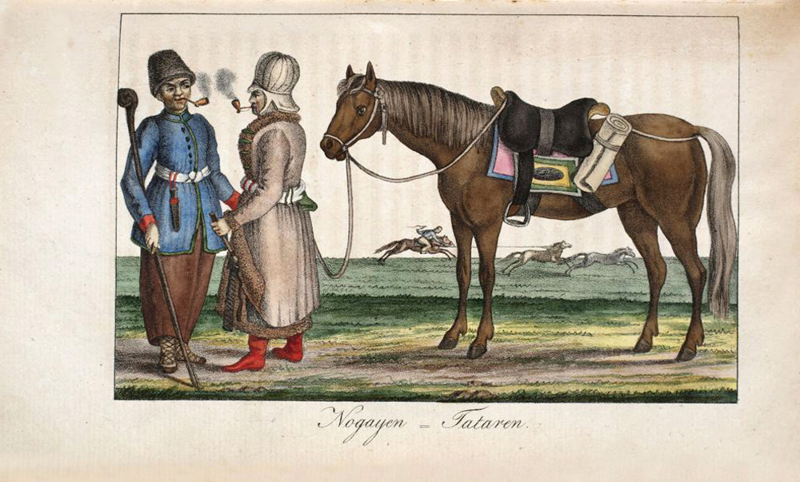
An attractive example. Schlatter, a Swiss missionary, gives a detailed and vital ethnographical account of his stay among the Nogayen-Tartars on the Sea of Azov. To an extent, Schlatter was traveling in the footsteps of German naturalist and explorer P.S. Pallas, who journeyed through the Nogai lands in October 1794, providing the earliest glimpse of the Melitopol Nogais.




- Published
- St. Gallen: Huber & Co., 1830.
- References
- Lipperheide Kaa45; Colas 2666; Longchamp 2656; Engelmann II 860; Bobins 1015. Not in Nitsche/Stender.
- Plates
- 13
- Binding/Size
- S=8vo
- Value
- 0-5000
- Published
- St. Gallen: Huber & Co., 1830.
- Ref
- 5189
[Fragments from some trips to the searchable Rubland in the years 1822-1828.] FIRST EDITION, 8vo, half-title, title, preface, xx, 496pp.text, 4pp., 14 lithographed plates of which 12 are hand-coloured, and one large folding lithographed map by H. Bienz of Basle, original decorated pale green paper-covered boards, hand-coloured armorial arms bearing the name 'Schlatter' and paper bookseller label on front pastedown. A second revised edition appeared in 1838. Schlatter made three journeys to Southern Russia and to the North Coast of the Sea of Azov. His lithographs show Tartar costumes, habitations, and Tartar and Turkish script. The plates by J. Locherer after J. Bienz shows the German, Bulgarian, and Jewish colonies in the area, giving geographical names of towns, rivers, etc. Traveling from east to west, Pallas met with three Nogai clans and the Yedissand horde that ranged along the Molochna River. The first state-appointed Nachalnik (chief) of all Nogais in the region, Baiazet Bey, was drawn from the latter. At this date, the Nogais whom Pallas saw had only recently arrived in the Molochna and unsurprisingly retained semi-nomadic practices. Schlatter’s work is an essential contribution to the history of this fascinating and challenging area. Coloured plates in order: 1. Armorial arms of the Schlater family. 2. Frontispiece. Tatarischer Edelmann. 3. Tatarische Wirthschaft (folding). 4. Tatarischer Pferdehirt. 5. Noyayen - Tataren. 6. Tataren. 7. Tatarische Frau. 8. Eine Tatarinn spinnend. 9. Nogay Tatarische Madchen. 10. Tatarinnen. 11. Vorhaus oder Kuche. 12. Inneres Zimmer eines Tataren Hauses. 13. [Map] Gebiet der Angesiedelten Nogagen-Tataren am Asow Schen Meere nebst den angranzenden Landern und teutschen Colonien, 1829.


