
If you would like to get in touch, please feel free to contact: email hidden; JavaScript is required
Browse collection
- Full collection
- 18th Century & earlier
- Ackermann
- Africa
- Alken
- Animals
- Arabasia
- Architecture/Mansions
- Art
- Australasia
- Botany
- British Isles
- Caricatures
- Children
- China
- Chromo added colour
- Chromolithographs
- Conchology
- Costume
- Cruikshank
- Culture/Lifestyle
- Dutch
- East European
- Far East
- France
- Furniture/Antiques
- General
- Germany
- Grandville
- Heraldry
- History
- History - England
- History - Europe
- Holy Land
- India
- India - sepia
- Islam
- Italy
- Japan
- Literature
- London
- Manuscript
- Map
- Military
- Monnier
- Natural history
- Pastimes
- Pochoir
- Polar regions
- Portraits
- Religious/Christian
- Religious/other
- Rowlandson
- Russia
- Science
- Scrapbook
- Sepia
- South America
- Sports/Hunting
- Stamps
- Swiss
- The Americas
- Theatre
- Travel/Scenery
- Watercolours
- World
MALTON, James.
An Essay on British Cottage Architecture.
"Malton had succumbed, deeply, to the influence of Uvalde Price. He was unwilling to accept Dr. Johnson's definition of the cottage as `a mean habitation,' regarding it rather a a hallowed sanctuary.a symbol of a particularly British tradition, to be upheld and preserved at all costs." Malton also made a plea, surprisingly early for preservation, noting, unless protected they will exist "no where but on the canvas of the painter." (ABBEY LIFE 34. ARCHER 197.1 ) Malton's designs set the image of the picturesque dwelling that was to survive as the popular ideal in England for a hundred years or more.






- Published
- London: Published by Hookham and Carpenter, Booksellers; and to be had at Taylor’s Architectural Library; at Egerton’s Military Library; of Mr Wilkinson, Map and Printseller; and of the Author, 1798.
- References
- Abbey Life 34 cites uncolored copy; Berlin Kat.2309 cites 1804 edition. Bobins 874.
- Plates
- 15 + 6
- Binding/Size
- M=4to
- Value
- 0-5000
- Published
- London: Published by Hookham and Carpenter, Booksellers; and to be had at Taylor’s Architectural Library; at Egerton’s Military Library; of Mr Wilkinson, Map and Printseller; and of the Author, 1798.
- Ref
- 5373
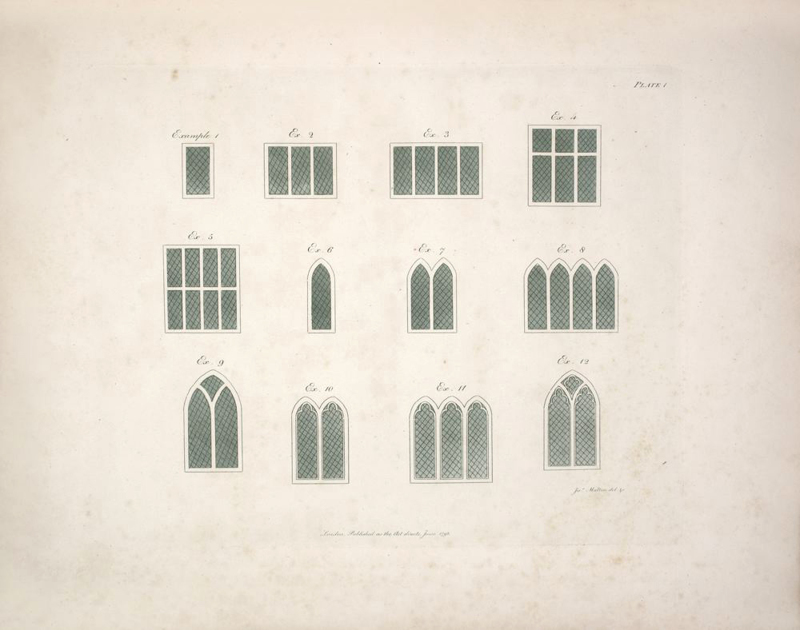
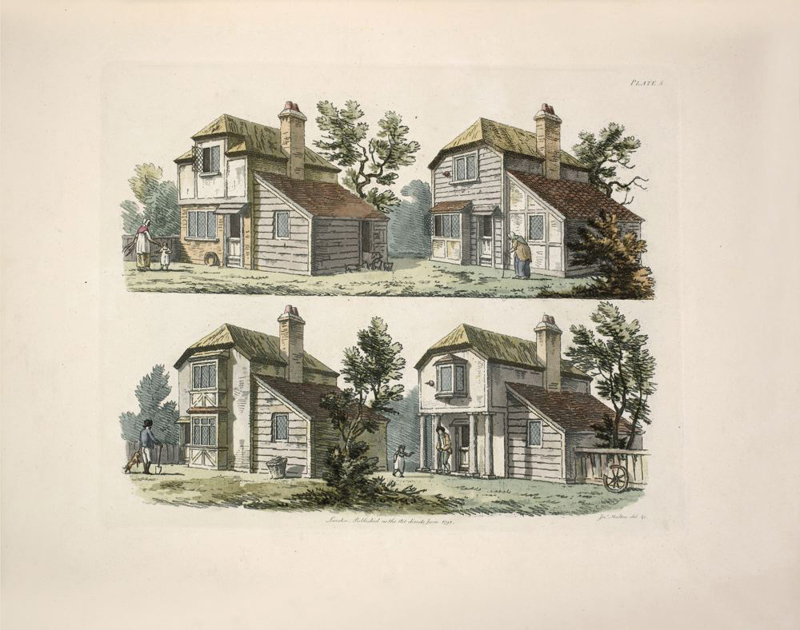
An Essay on British Cottage Architecture; being an attempt to perpetuate on the principle that a peculiar mode of building, which was initially the effect of chance. Supported by fourteen designs, with their Iconography, or plans, laid down to scale; comprising dwellings for the peasant and farmer, and retreats for the gentlemen, with various observations thereon: the whole extending to twenty-one plates, designed and executed in aquatints by James Malton. First edition. 4to, large paper copy, half-title, title, introduction pp. 1-12, text pp. 12-27, 21 aquatint plates and plans comprising 14 hand-coloured plates and one uncoloured, 6 plans printed in sepia. Contemporary speckled calf, re-backed preserving part of old spine, new morocco label. Unlike contemporary architects, who advocated order, regularity, and symmetry in domestic design, Malton wanted to “perpetuate [...] the peculiar beauty of the British picturesque, rustic habitations,[which were] the most pleasing, the suitable ornaments of art that can be introduced to embellish rural nature.” Coloured plates in order: 1. A series of window designs (12 figs). 2. A cottage, and two window designs, and two bars. 3-4. A pair of almost identical rustic cottages. 5. Four very similar rustic cottage designs. 6. A single-storey rustic cottage. 7. A two-storey country dwelling. 8. A series of various plans and designs for the cottages mentioned above (sepia). 9. A two-storey country cottage. 10. A more expensive two-storey country cottage with more sophistication. 11. A series of assorted plans and designs for the above-mentioned cottages (sepia). 12. A two-storey cottage with twin columns and bay windows etc. 13. A two-storey cottage with four columns, shuttered windows, etc. 14. A series of plans and designs for the cottages mentioned above (sepia). 15. A more substantial and sophisticated two -torey dwelling. 16. A larger two-storey dwelling with wooden facia boards, thatch, columns, etc. 17. A series of plans and designs for the cottages as mentioned earlier (sepia). 18. A single-storey cottage with twin columns and a thatched roof etc. 19. A pair of plans and designs for the cottage as mentioned above - including cut-through sections (sepia). 20. A substantial three-storey cottage with front steps, columns, thatched roof, graveled driveway, numerous windows, tiles, etc. 21. Plan and design for the cottage mentioned above (sepia).


