
If you would like to get in touch, please feel free to contact: email hidden; JavaScript is required
Browse collection
- Full collection
- 18th Century & earlier
- Ackermann
- Africa
- Alken
- Animals
- Arabasia
- Architecture/Mansions
- Art
- Australasia
- Botany
- British Isles
- Caricatures
- Children
- China
- Chromo added colour
- Chromolithographs
- Conchology
- Costume
- Cruikshank
- Culture/Lifestyle
- Dutch
- East European
- Far East
- France
- Furniture/Antiques
- General
- Germany
- Grandville
- Heraldry
- History
- History - England
- History - Europe
- Holy Land
- India
- India - sepia
- Islam
- Italy
- Japan
- Literature
- London
- Manuscript
- Map
- Military
- Monnier
- Natural history
- Pastimes
- Pochoir
- Polar regions
- Portraits
- Religious/Christian
- Religious/other
- Rowlandson
- Russia
- Science
- Scrapbook
- Sepia
- South America
- Sports/Hunting
- Stamps
- Swiss
- The Americas
- Theatre
- Travel/Scenery
- Watercolours
- World
RICHARDSON (George)
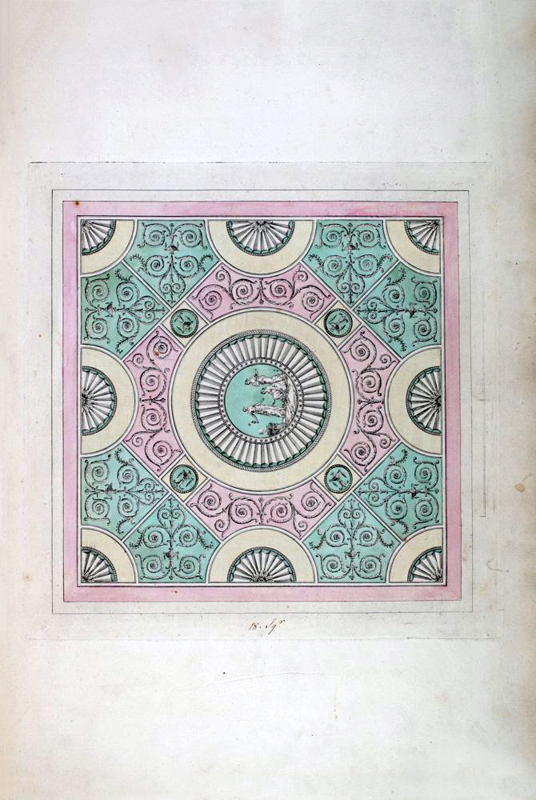
A Book of Ceilings, in the Style of the Antique Grotesque...
The work was available with plates uncoloured, or with plates having coloured grounds, or (in a few cases) with plates 'coloured and touched up in the manner of finished drawings' In the Preface to this, his first published work Richardson declares himself a former student of the Adam brothers, states that many clients and architects have already patronised his designs, and commends them not only to persons of taste but also to artists, architects, builders, plasterers, students, and mechanics. So successful were Richardson's books of neoclassical designs that he never took up a career as an architect himself. His agents distributed his books not only in London, Edinburgh, and Dublin but even as far away as Vienna.




- Published
- London: Printed for the Author, 1776.
- References
- Abbey, Life. 56; Archer 428.2; Harris 735; Berlin Kat. 3995.
- Plates
- 6
- Binding/Size
- L=FOLIO
- Value
- 0-5000
- Published
- London: Printed for the Author, 1776.
- Ref
- 1497
FIRST EDITION. large folio, [6], ii, [2], ii, 11, [1]pp., title page in English and French with imprint taken from English part, with subtitle dated 1774, engraved dedication, list of subscribers and 'To the Public' leaf, parallel English and French texts, 48 etched plates of ceiling designs, plates 1 to 6 hand-coloured, measurements in manuscript, plates 7 to 12 with measurements in manuscript and signed by hand: 'G. Richardson Ft.' plate 40 double-page, some light foxing, expertly rebound in a cont. style half calf, spine in gilt compartments, red morocco title label, marbled boards, an attractive copy. Richardson had worked as a draughtsman in the office of Robert and James Adam before setting up on his own. Richardson published the present work, originally issued in parts from 1774, to illustrate his skills as an architectural draughtsman and was strongly influenced by the Adam style. The list of subscribers includes Duke of Buccleugh, Earl of Bute, Earl of Kerry, Duke of Northumberland, John Adam, William Chambers, William Ince, James Paine, and James Wyatt. However, there can be little doubt that it was Adam's folio of executed designs described in French and English that prompted Richardson to start publishing his works in a similar format in 1774. By then, according to his account, 'many of the nobility and Persons of Distinction and the most eminent Architects [had] already patronised [his ceiling designs]. and warmly recommended their publication'. (Harris) Coloured plates in order: 1. Plate 1. Anti Room. Nymphs preparing a sacrifice. 2. Plate 2. Dressing Room. Hercules and Omphale - this ceiling is executed for the Rt. Hon, the Lord de Montalt in Dublin, by Mr. Edward Robbins. 3. Plate 3. Drawing Room. The story of Vertumnus and Pomona. The boys in the smaller circles are allegorical representations of the seasons. 4. Plate 4. Bed Chamber. Mars and Venus attended by Cupid. 5. Plate 5. Library. Nymphs adorning a vase supposed to contain the ashes of a deceased companion. The boys and griffins in bas-relief are emblems of Love and Immortality. 6. Plate 6. Dining Room. The picture in the centre represents the Judgement of Paris; those in the end compartments are various Bacchanalian boys at play in imitation of antique bas-reliefs.
