If you would like to get in touch, please feel free to contact: email hidden; JavaScript is required
Browse collection
- Full collection
- 18th Century & earlier
- Ackermann
- Africa
- Alken
- Animals
- Arabasia
- Architecture/Mansions
- Art
- Australasia
- Botany
- British Isles
- Caricatures
- Children
- China
- Chromo added colour
- Chromolithographs
- Conchology
- Costume
- Cruikshank
- Culture/Lifestyle
- Dutch
- East European
- Far East
- France
- Furniture/Antiques
- General
- Germany
- Grandville
- Heraldry
- History
- History - England
- History - Europe
- Holy Land
- India
- India - sepia
- Islam
- Italy
- Japan
- Literature
- London
- Manuscript
- Map
- Military
- Monnier
- Natural history
- Pastimes
- Pochoir
- Polar regions
- Portraits
- Religious/Christian
- Religious/other
- Rowlandson
- Russia
- Science
- Scrapbook
- Sepia
- South America
- Sports/Hunting
- Stamps
- Swiss
- The Americas
- Theatre
- Travel/Scenery
- Watercolours
- World
[ANON]
A nice set of loose hand-coloured manuscript pages that once had the relevant stamps affixed to them - they are no longer present.


- Published
- [Unknown]
- Plates
- 28
- Binding/Size
- M=4to
- Value
- 0-5000
- Published
- [Unknown]
- Ref
- 1584
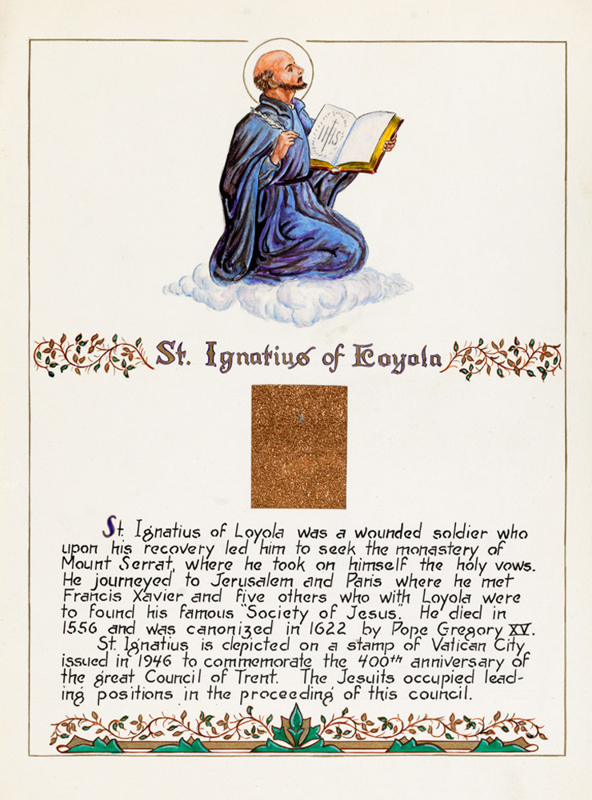
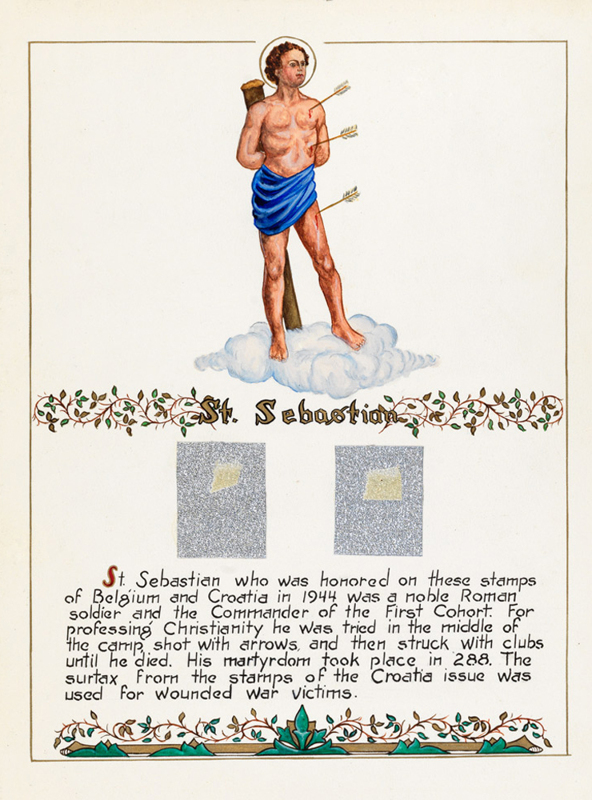
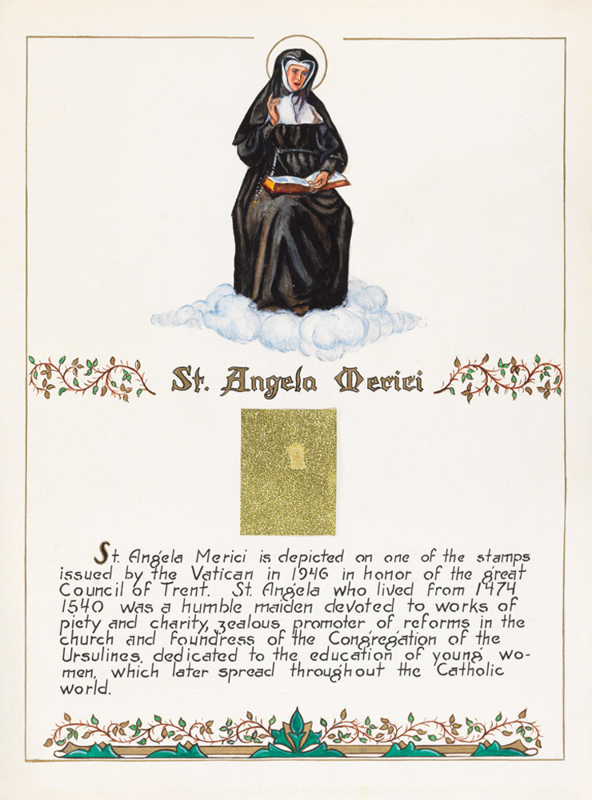
Housed in a modern full leather tan-coloured Solander box. Most pages allude to a historic saint, with a brief description, illustration, space for a stamp(s), and a decorative border, with ragged gilt edges. Coloured plates not in order: 1. St. Angela Merici is depicted on one of the stamps issued by the Vatican in 1946 in honor of the great Council of Trent. St Angela, who lived from 1474-1540, was a humble maiden devoted to works of piety and charity, zealous promoter of reforms in the church, and foundress of the Congregation of the Ursulines, dedicated to the education of young women, which later spread throughout the Catholic world. 2. The discovery of the corrupt body of St. Barnabas, the location of which was determined by a dream, is shown on this stamp of Cyprus. He was St.Paul's companion in converting the Gentiles of Asia Minor and Cyprus, where he was stoned to death there some years later at extremely old age. 3. This stamp is a reproduction of a window in the Church of St. Charles. It was issued in Monaco in 1951 to celebrate the Holy Year, which occurred in 1950. It represents St. Charles Borromee. He was Archbishop of Milan and a cardinal at 23. He tendered the sick during the plague epidemic and died in 1584. The Borromee and the royal family are related. 4. St. Christopher was a giant and robust who once served the devil. But he understood Christ was more powerful, so he began serving him by carrying travelers across a river. One day he was carrying a small boy, and he almost collapsed under the child's weight, then he realized he was carrying Jesus with the weight of our sins. He is the patron saint of travellers. 5. St. Elizabeth, Queen of Hungary, is honored on stamps of Hungary & Austria. She was devoted to studying religion and acts of charity, which her husband forbid. On one occasion, he saw her with a bundle of bread and ordered her to open it; upon doing so, he saw not bread but roses. After his death, she renounced all power and lived in seclusion, doing penance and ministering to the sick. She died in 1231 and was canonized in 1235. 6. St. Francis of Assisi wore a coarse brown garb and walked through the hills of Umbria, Italy preaching the Gospel. Other young men joined him in this life of happy poverty - thus began the Franciscan Order. His love of animals, trees, and flowers was great. He preached a sermon to the birds. The' Poor Clares,' an order for women, was also started by him. In 1226 he died and two years later was canonized. 7. St. Francis Xavier was sent to Asia as a missionary in 1540. He died in China in 1552. In 1662 he was canonized, and in 1747 was pronounced the patron Saint of the East Indies. This stamp issued in 1923 bears a portrait of St. Francis and the badge of the Jesuit Order in the corner. 8. St. Ignatius of Loyola was a wounded soldier who, upon his recovery, led him to seek the monastery of Mt. Serrat, where he took himself the holy vows. He journeyed to Jerusalem and Paris, where he met Francis Xavier and five others who were to found the famous 'Society of Jesus' with Loyola. He died in 1556 and was canonized in 1662 by Pope Gregory XV. St. Ignatius is depicted on a stamp of Vatican City issued in 1946 to commemorate the 400th anniversary of the great Council of Trent. The Jesuits occupied leading positions in the proceeding of this council. 9. St. James The Greater, a near relative, was one of the three Apostles Jesus kept nearest to Him. He preached the Gospel in Spain. Returning to Jerusalem, he was beheaded by order of Agrippa and was the first martyr among the Apostles. Spain issued stamps in 1936 and in 1943 honoring St. James, both commemorating Holy Years. 10. France and Indo-China honor St. Joan of Arc by issuing stamps. Under the guidance of St. Catherine and St. Margaret, whose voices she heard, Joan of Arc led the army of France and drove out the English. Later she was burned at the stake by the English because she crusaded against them. 11. Issued by France & Brazil in honor of the 300th anniversary of the birth of John the Baptiste de la Salle, a French prelate who founded the Christian Brothers, a teaching order of Catholic clergymen. He was canonized in 1900 and is the 'patron of teachers.' 12. St. John of God, born in Portugal, was a soldier under Charles V of Spain, heard a sermon by John of Avila which stirred his soul, and under the great direction of the same holy man entered upon a career of practical charity by supporting the homeless and helpless poor. He died in 1550. 13. St. Michael, Patron saint of Belgium, is shown on two stamps of Belgium issued to advertise the Brussels Exhibition of 1896-97. The Devil is represented as a Dragon. Lucifer, full of pride at his angelic power, defied God and challenged him. God sent Michael the Archangel against Lucifer and drove him into the pits of hell. The tabs bear the words "Do not deliver on Sunday." 14. To honor St.Patrick, Ireland issued this new stamp in 1949. When Ireland was the land of the Druids, there was a Bishop Patrick, who came to teach the word of God. One day a group of his followers came to him and admitted that it was difficult to believe in the doctrine of the Holy Trinity. Bishop Patrick, bending down, plucked a leaf from a shamrock bidding them to behold the living example of the three in one. 15. The first canonical saint chosen from the western shores of the Atlantic appears on this stamp of Peru issued in 1937. At a very early age, St. Rose took the habit and vows of the third order of St. Dominic. She died at the age of 31 in Lima, Peru, and was canonized in 1671 by Pope Clement X. 16. St. Sebastian, who was honored on these stamps of Belgium and Croatia in 1944, was a noble Roman soldier and the Commander of the First Cohort. He was tried in the middle of camp for professing Christianity, shot with arrows, and then struck with clubs until he died. His martyrdom took place in 288. The surtax from the stamps of the Croatia issue was used for wounded war victims. 17. St. Ursula is depicted on this stamp issued in 1899 in the Virgin Islands, which were discovered by Christopher Columbus in honor of the saint. According to a legend, St. Ursula was returned from a pilgrimage to Rome with a group of virgins when near Cologne, a horde of Huns attacked and killed them. The religious order of Ursuline Sisters was named after St. Ursula. 18. St. Vincent de Paul, a French priest patron saint of charitable works, lived from 1576-1660. In Paris, he started the "Lazarites' of 'Fathers of the Mission' and later 'The Congregation of the Sisters of Charity.' He did great work for the hospitals of Paris. In 1737 he was canonized. 19. The monogram "A.M.' for Annus Marianus (Marian Year) decorates each of the six stamps issued by Vatican City for the Marian Year. Pope Pius IX is portrayed on three of the stamps with a Latin inscription: 'Pope Pius IX Solemnly Established the Dogma of the Immaculate Conception 1854-1954'. The present pontiff, Pope Pius XII is pictured on the other three values with the inscription: "Pope Pius XII Proclaimed the Marian Year on Dec 8, 1953.' 20. Vatican City marked the end of the Marian Year by releasing this set of stamps reproducing the Venerated 16th century painting "Mother of God of the Holy Gate," sometimes known as the Black Virgin. This painting disappeared from the chapel in the gate of Vilna, Poland, after the Russians retook the city in 1944. Below the image, the stamps are inscribed "Mater Misericordeiae" (Mother of Mercy). 21. Italy honored the Marian year with the issuance of two stamps, each a different portrait of the Holy Mother. The 25 lire design shows a detail from a painting by Perugino now in a gallery in Florence, Italy. The 60 lire stamp depicts a detail from the "Pieta" by Michelangelo. 22. Toi commemorates the Marian Year, the Saar issued three stamps reproducing a famous painting of the Madonna and Child. (The Madonna of The Mayor of Basel by Holbein), (The Sistine Madonna by Raphael), (The Madonna and Child with the Pear by Durer). 23. The Philippines issued this stamp for the Marian year. The design reproduces the well-known painting "The Immaculate Conception" by Murillo. A 14th-century wood carving of the Virgin Mary, which is in the National Museum in Vaduz, is reproduced on the above stamps issued by Liechtenstein. 24. During the Congress of the Patroness of Brazil held to celebrate the 100th anniversary of the proclamation of the Dogma of the Immaculate Conception, Brazil issued stamps. The 60c depicts Our Lady of Aparecide as Patroness of Brazil and the 1.20cr the Holy Mother. The stamps above were issued by Matta and feature a reproduction of the central altarpiece in the Collegiate Parish Church of Cospicua. 25. Eire issued the above stamps for the Marian Year. They depict a terracotta relief of the Madonna and Child by de Robbia, which is in a chapel of a church in Florence, Ital;y. The Dominican Republic offers three airmail stamps as a postal tribute for the Marian Year. The design spotlights a large "A.M." monogram for Ano Mariano with seven radiant stars above it. 26. (Our Lady of the Pillar), (The Voyadonga Virgin), Virgin of the Kings), (The Almudena Virgin), (a blank caption space), Our Lady of Guadelupe). 27. Spain commemorates the Marian Year by releasing the following stamps with designs reproducing Spanish works of art venerating the Blessed Virgin Mary. ("Purisima"), ("Our Lady of Begona"), ("Our Lady of The Abandoned"), ("The Black Virgin"). 28. Monaco issued the three stamps below to honour the Blessed Mother. The 5fr shows a detail from a triptych by Francesco Brea (1540). The 10fr is a detail from Luigi Brea's Monaco Cathedral's altarpiece. The design of the 15fr is from a wooden statue of "Blessed Rainer" in the church of St. Charles, Monte Carlo.